
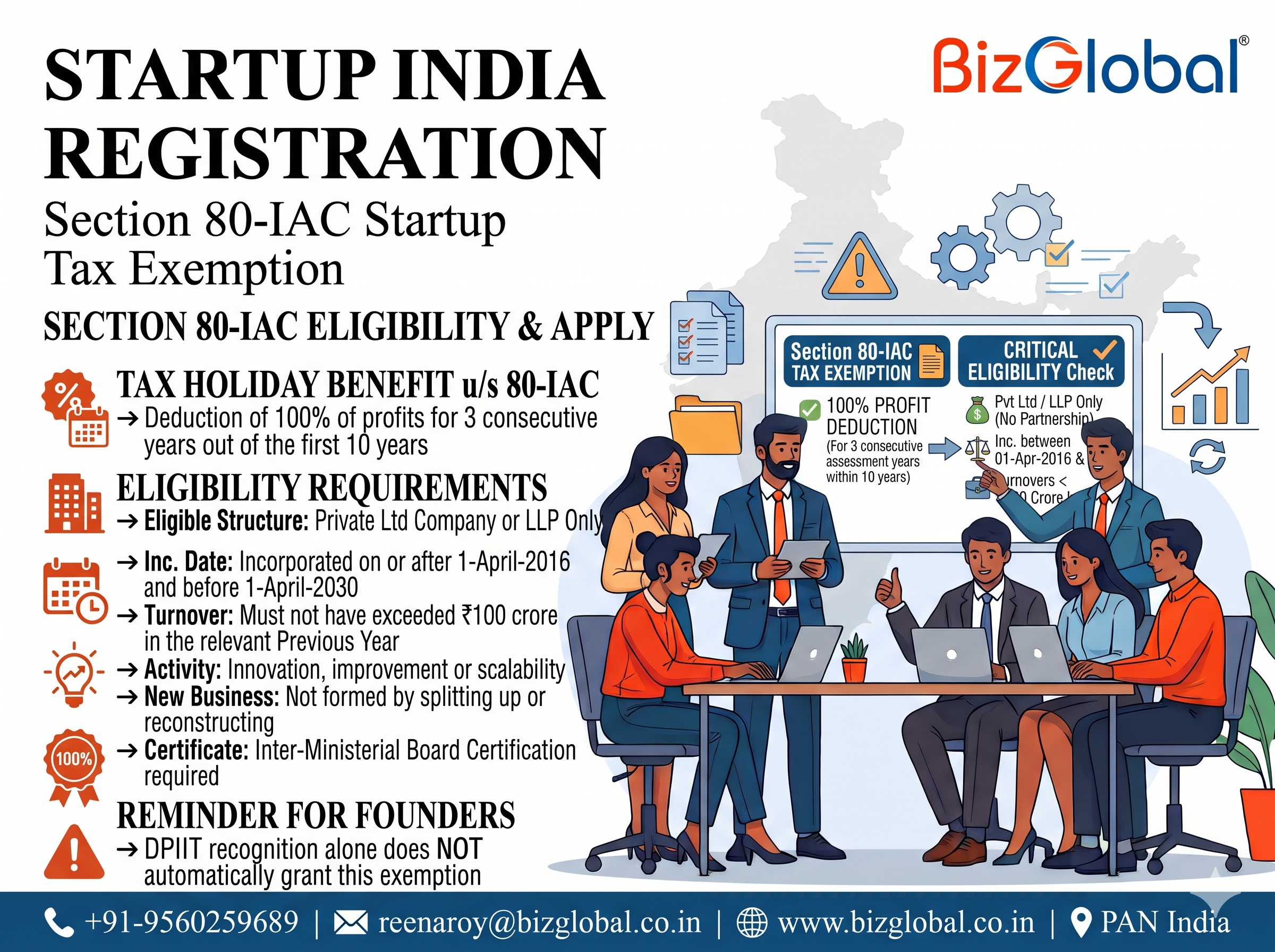
For an eligible startup, managing taxes effectively can make a meaningful difference to its growth plans. The Government of India provides a profit-linked tax deduction under Section 80-IAC for qualifying startups. However, obtaining recognition under the Startup India initiative does not automatically make a business eligible for this tax benefit.
Understanding the Section 80-IAC startup tax exemption is important for founders planning their finances, assessing eligibility and preparing the required application documents. This guide explains the benefit, eligibility conditions, application process and common points to check before applying.
What Is Section 80-IAC Startup Tax Exemption?
Section 80-IAC of the Income-tax Act, 1961 provides an eligible startup with a deduction of 100% of the profits and gains derived from its eligible business for three consecutive assessment years out of the ten years beginning from the year of incorporation. The startup can choose the three consecutive years in accordance with the applicable provisions.
In simple terms, an eligible startup may claim a deduction for its eligible business profits for the selected period, subject to the prescribed conditions.
This is a deduction, not an unconditional exemption from every tax liability.
Who Is Eligible for Section 80-IAC?
Under the current published framework, the key requirements include the following.
1. Eligible Legal Structure
The applicant must be a private limited company or a Limited Liability Partnership (LLP). A registered partnership firm may qualify for DPIIT recognition but is not eligible to claim the Section 80-IAC deduction under this provision.
2. Incorporation Date
The business must have been incorporated on or after 1 April 2016 and before 1 April 2030, subject to the applicable law and conditions.
3. Turnover Limit
The startup's turnover must not have exceeded ₹100 crore in the relevant previous year for which the deduction is claimed. This is an important distinction from the general DPIIT recognition framework, which has a different turnover threshold.
4. Eligible Business Activity
The business should be engaged in innovation, development or improvement of products, processes or services, or operate a scalable business model with high potential for employment generation or wealth creation.
5. No Prohibited Business Restructuring
The startup must not have been formed by splitting up or reconstructing an existing business, subject to the applicable statutory provisions and exceptions.
6. Required Certification
The startup must obtain the required certificate of eligible business from the Inter-Ministerial Board of Certification, through the prescribed application process.
Is DPIIT Recognition Enough to Claim the Deduction?
No. DPIIT recognition and approval for Section 80-IAC are separate steps.
DPIIT recognition establishes that an entity qualifies under the startup recognition framework. The tax deduction, however, has additional conditions, including the eligible entity type, incorporation period, turnover limit and required certification.
For a broader explanation of the difference, read our guide on DPIIT Recognition vs Startup India Benefits.
Seek Guidance on Eligibility and Documents
Section 80-IAC can be valuable for an eligible startup, but founders should assess the conditions carefully before planning around the deduction. BizGlobal can be approached to discuss eligibility and document-preparation requirements, subject to confirmation of the services offered. For tax-specific advice, consult a qualified tax professional.
Disclaimer: Tax law and application requirements may change. The deduction should be assessed against the provisions applicable to the relevant tax year, with professional advice where necessary.