
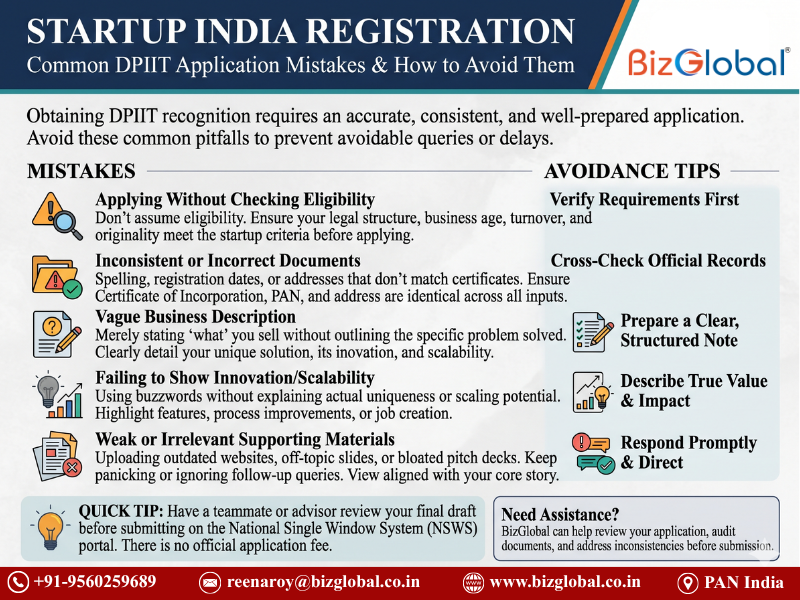
Applying for DPIIT Startup Recognition is an important step for eligible businesses looking to explore opportunities under the Startup India initiative. However, preparing an application involves more than filling in an online form. Founders must understand the eligibility conditions, provide accurate entity information and clearly explain their business model.
This guide explains common startup recognition errors, why they matter and how founders can prepare a more accurate application.
1. Applying Without Checking Eligibility
One of the first mistakes is starting the application without confirming whether the business qualifies for recognition.
Applicants should review their legal structure, age, turnover, innovation or scalability criteria and the requirement that the entity must not have been formed by splitting up or reconstructing an existing business.
How to avoid it: Review the current eligibility requirements before starting the application. If the entity's legal structure, business history or DeepTech status raises questions, clarify the position before proceeding.
Read our related guide on DPIIT Startup Recognition Eligibility: Who Can Apply? for a detailed explanation of the criteria.
2. Providing Incorrect or Inconsistent Startup Documents
Incorrect startup documents are another common source of avoidable complications. For example, the legal name, incorporation date or entity details entered in the application may differ from the relevant official records.
How to avoid it: Keep the Certificate of Incorporation or Registration Certificate, PAN and other relevant records ready. Cross-check the legal name, registration details, address and dates before submitting the application. If the entity's information has changed, verify the applicable official records rather than relying on outdated documents.
3. Writing a Vague Business Description
A business description that merely states what a company sells may not adequately explain why it meets the recognition criteria.
The application should clearly communicate how the business works towards developing or improving a product, process or service, or how its scalable business model has significant potential for employment generation or wealth creation.
How to avoid it: Prepare a concise business note that answers four questions:
- What problem does the startup address?
- What product, service or process does it offer?
- What is innovative or improved about its approach?
- How can the business scale or generate employment and wealth?
4. Failing to Explain Innovation or Scalability
Innovation is not established simply by using technology, operating online or describing a business as different. Founders need to explain the substance of their offering and how it meets the applicable criteria.
How to avoid it: Explain the product's features, the process improvement, the customer problem or the business model's growth potential. Supporting material, such as a website, pitch deck, product video or patent-related information, may help communicate the business where relevant.
5. Submitting Weak or Irrelevant Supporting Material
Supporting material should help reviewers understand the business, not simply make the application look more substantial. A lengthy presentation that does not explain the product, innovation or revenue model may add little value.
Outdated websites, inconsistent pitch decks and promotional claims that do not match the application can also create confusion.
How to avoid it: Review your supporting material before submission. Ensure that it reflects the current business, explains the product or service clearly and supports the information entered in the application. Use relevant material rather than uploading documents without a clear purpose.
Our guide on Startup India Registration: Documents Required & Application Process can help you organise the information before applying.
6. Not Responding Properly to a DPIIT Clarification
A clarification request does not necessarily mean that an application has been rejected. It may indicate that additional information or an explanation is needed to assess the application.
How to avoid it: Read the clarification carefully and identify exactly what information is requested. Prepare a direct response supported by relevant records, where applicable. Check that the response remains consistent with the original application and follow the instructions and timelines communicated through the relevant portal.
If the issue concerns eligibility or the interpretation of the applicable criteria, seek appropriate professional guidance before responding.
Review Your Application Before Submission
A careful review can help identify preventable errors before the application is filed.
BizGlobal can help you review your application preparation and identify documentation or information gaps, subject to confirmation of the services offered. The aim is to help you approach the DPIIT recognition process with greater clarity before submission.
Disclaimer: This article provides general information. Verify the latest eligibility conditions and application instructions through the official Startup India and NSWS portals.