
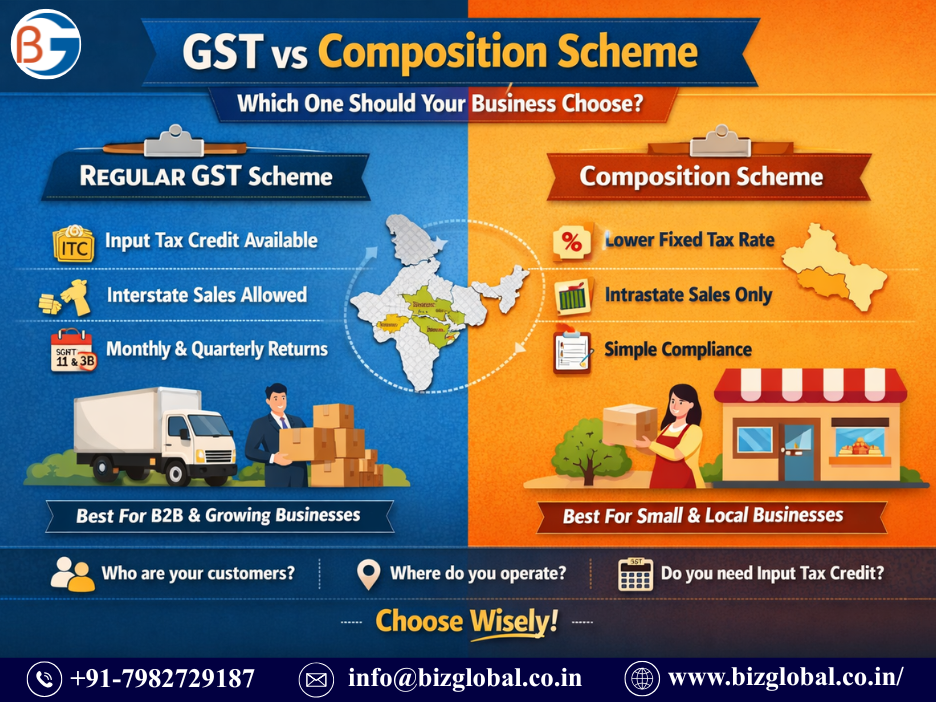
When you start or run a business in India, one of the most important decisions you will make is choosing the right GST structure. While the Goods and Services Tax system aims to simplify indirect taxation, it also offers two different pathways for taxpayers. These are the Regular GST Scheme and the Composition Scheme.
At first glance, the Composition Scheme looks attractive because of its simplicity and lower tax rates. But is it always the right choice? Not necessarily. Let us break it down in a clear and practical way so you can decide what works best for your business.
Understanding the Basics
Under the Regular GST Scheme, businesses collect GST from customers and can claim input tax credit on purchases. This means you can offset the tax you pay on inputs against the tax you collect on sales.
On the other hand, the Composition Scheme is designed for small taxpayers. It allows businesses to pay tax at a fixed, lower rate on turnover without dealing with complex compliance. However, it comes with restrictions.
Key Differences Between GST and Composition Scheme
Here is a simple comparison to understand the core differences:
|
Particulars |
Regular GST Scheme |
Composition GST Scheme |
|
Meaning |
Registered taxpayer collects & pays GST |
For small taxpayers (turnover ≤ ₹1.5 Cr) with lower tax & quarterly returns |
|
Turnover |
|
Rs 20 lakhs/ 40 lakhs depending on the state and nature of business Refer GST Registration Thresholds |
|
Filing of Returns |
GSTR-9/9C (Annual), GSTR-3B (Monthly), GSTR-1 (Monthly/Quarterly) |
GSTR-4 (Annual), GST-9A (Annual), CMP-08 (Quarterly) |
|
Supply |
Interstate & intrastate allowed |
Only intrastate allowed |
|
Tax Collection |
GST at regular rates |
GST at lower fixed rate |
|
Tax Rates |
Standard rates apply such as 5%, 12%, 18%, or 28% depending on the product or service |
Lower fixed rates such as 1% for traders and manufacturers; 5% for restaurants; 6% for service providers (under specific conditions) |
|
Supply Services |
All services allowed |
Only specific services allowed |
|
ITC |
Allowed |
Not Allowed |
|
Not Eligible to Opt |
No restriction |
Interstate suppliers, e-commerce sellers, tobacco/ice cream/pan masala makers, turnover > limit |
|
Specified Condition |
No PAN entity can be both regular & composite |
No ITC, no exempt supply, services ≤10% or ₹5L, must show “composition taxable person,” RCM applies |
|
Documents |
Tax Invoice |
Bill of Supply |
|
GST Payment |
Output GST – Input GST + RCM |
GST on supplies + RCM (out of pocket) |
|
Merits |
Unlimited territory, ITC available, e-commerce allowed |
Less compliance, small tax, no ledger, better liquidity |
|
Demerits |
More compliance, less liquidity, dependent on supplier filing |
Limited territory, no ITC, no exempt supply, no e-commerce |
|
Restriction on SEZ |
No restriction |
Not allowed to supply to SEZ |
|
Condition to Opt-Out |
Can opt out anytime |
Can opt out only at year end |
|
Customer Base |
Suitable for B2B and B2C businesses |
Best suited for B2C businesses because customers cannot claim input tax credit |
When Should You Choose the Composition Scheme?
The Composition Scheme is ideal for small, local businesses that want to keep things simple.
You should consider it if:
- Your turnover is below the prescribed threshold
- You deal mostly with end consumers
- Your business operates within one state
- You want minimal compliance and paperwork
Example:
A small bakery in Noida with an annual turnover of Rs. 40 lakh and mostly walk-in customers would benefit from the Composition Scheme. The owner can pay tax at a lower rate without worrying about complex GST filings.
When is Regular GST the Better Option?
The Regular GST Scheme is better suited for growing or larger businesses.
You should choose it if:
- You want to claim input tax credit
- You deal with other businesses that require GST invoices
- You sell goods across states
- You plan to scale your operations
Example:
A wholesale electronics trader sourcing goods from different states and selling to retailers would prefer regular GST. Input tax credit alone can significantly reduce the overall tax burden.
Hidden Costs and Common Mistakes
Many businesses choose the Composition Scheme for its lower tax rate but overlook its limitations.
Here are a few common mistakes:
- Ignoring the loss of input tax credit, which can increase actual costs
- Choosing composition despite having B2B clients who prefer GST invoices
- Not planning for future growth and exceeding turnover limits
A lower tax rate does not always mean lower tax liability in practice.
Practical Guidance for Choosing the Right Scheme
Before making your decision, ask yourself these questions:
- Who are your customers, businesses or individuals?
- Do you purchase goods with significant GST input?
- Do you plan to expand beyond your state?
- Is compliance simplicity more important than tax savings?
A good rule of thumb is this:
If your business is small, local, and consumer-focused, the Composition Scheme can work well. If your business is growing, interconnected, or input-heavy, Regular GST is usually the better choice.
How Bizglobal Can Help You
Choosing the right GST scheme is not just a one-time decision. It requires proper evaluation of your business model, future plans, and compliance requirements.
This is where Bizglobal can make a real difference.
Bizglobal offers:
- Expert consultation to determine the most suitable GST scheme
- Assistance with GST registration and documentation
- Ongoing compliance support including return filing
- Guidance on switching between schemes when your business grows
- Strategic tax planning to reduce liability legally
Final Thoughts
There is no one size fits all answer when it comes to GST vs Composition Scheme. The right choice depends on your business size, operations, and long-term goals.
The Composition Scheme offers simplicity and ease, while Regular GST provides flexibility and tax benefits. The key is to align your choice with your business strategy rather than just opting for the easier route.
If you are still unsure, it is always better to seek professional guidance. A well-informed decision today can save you from compliance headaches and financial losses tomorrow.
Don’t know which scheme suits you best?
Contact +91-8447245045 and our team will guide throughout.