
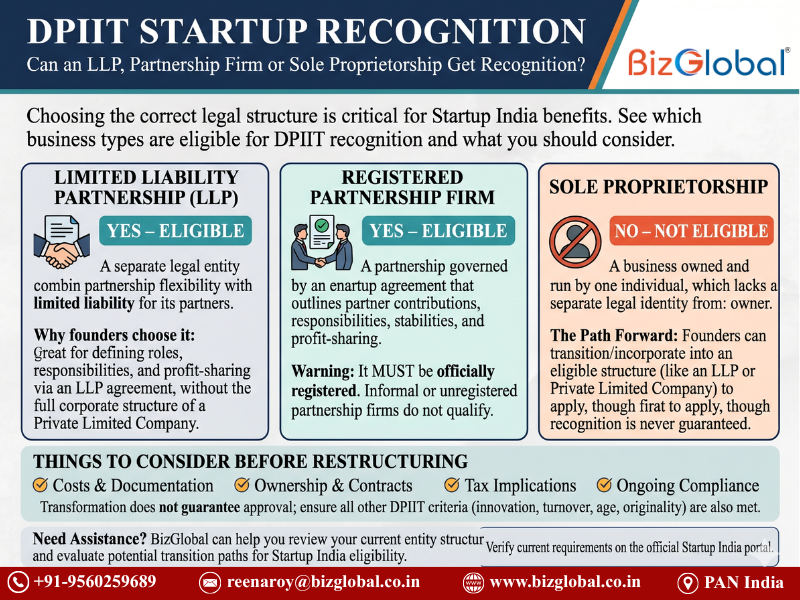
Choosing the right legal structure is an important decision for entrepreneurs starting a business in India. It affects ownership, liability, compliance requirements and future growth opportunities. For founders exploring Startup India benefits, one question often comes up: can a Limited Liability Partnership (LLP), Partnership Firm or Sole Proprietorship obtain DPIIT Startup Recognition?
This guide explains which entity types can apply, how their structures differ and what entrepreneurs should consider before applying or restructuring their businesses.
1. Can an LLP Get DPIIT Recognition?
Yes, an eligible Limited Liability Partnership can apply for DPIIT recognition.
An LLP is a separate legal entity that combines features of a partnership with limited liability for its partners, subject to the applicable law. It is often considered by founders who want a structured business arrangement without adopting the full corporate structure of a private limited company.
Why might founders choose an LLP?
An LLP may be suitable for founders who want to define partners' roles, profit-sharing arrangements and responsibilities through an LLP agreement. It can also provide limited liability protection, subject to the law and circumstances.
2. Can a Registered Partnership Firm Get DPIIT Recognition?
Yes, a registered partnership firm may qualify for DPIIT recognition, provided it satisfies the applicable conditions.
A partnership firm is generally governed by a partnership agreement that sets out the relationship between partners, their contributions, profit-sharing arrangements and responsibilities. Registration of the partnership firm is important when assessing its eligibility under the startup recognition framework.
Entrepreneurs should not assume that an informal or unregistered partnership automatically qualifies simply because it operates as a startup. They should verify the legal status of the firm and the current requirements before beginning the application.
3. Can a Sole Proprietorship Get DPIIT Recognition?
No. A sole proprietorship cannot directly obtain DPIIT recognition in its existing form.
A sole proprietorship is a business owned and operated by one individual. Unlike an LLP or company, it does not have a separate legal identity from its proprietor in the same way.
This does not mean that a sole proprietor cannot build an eligible startup. The entrepreneur may consider moving to an eligible legal structure, such as an LLP or private limited company, if it suits the business's requirements.
However, changing the legal structure does not automatically guarantee DPIIT recognition. The resulting entity must meet the applicable eligibility conditions, and the treatment of the business's existing history should be verified under the current rules.
Before restructuring, consider the costs, documentation, contracts, tax implications, ownership arrangements and compliance obligations involved. The decision should be based on the business's overall needs, not solely on the possibility of obtaining recognition.
Check Your Entity Structure Before Applying
An LLP or registered partnership firm can be eligible for DPIIT recognition, while a sole proprietorship cannot apply directly in its existing form. Nevertheless, legal structure is only one part of the eligibility assessment.
BizGlobal can help you review your entity structure and understand the relevant eligibility and application requirements, subject to confirmation of the services offered. Before making a restructuring decision, evaluate the legal, financial and operational implications alongside your startup recognition objectives.
Disclaimer: Legal structure and recognition eligibility should be assessed against the latest applicable rules. Verify current requirements through the official Startup India portal before applying.