
Starting a business involves more than having a good idea. Founders also need the right legal structure, access to resources and opportunities to grow. The Government of India launched the Startup India initiative to encourage innovation, entrepreneurship and sustainable business development. One of its key features is DPIIT Startup Recognition, which helps eligible businesses access various government schemes and benefits.
However, incorporating a business does not automatically make it a recognised Startup. Businesses must apply separately and satisfy the prescribed eligibility conditions. This guide explains the Startup India registration process, eligibility criteria, documents required and benefits available to eligible Startups.
What is Startup India Registration?
Startup India is a government initiative launched on 16th January, 2016 to promote entrepreneurship and create a supportive ecosystem for Startups. The Department for Promotion of Industry and Internal Trade (DPIIT), under the Ministry of Commerce and Industry, oversees the recognition framework.
In common usage, Startup India registration refers to obtaining DPIIT recognition. It is important to distinguish this from business incorporation.
Business incorporation legally establishes an entity, such as a Private Limited Company or LLP. DPIIT recognition is a separate approval that confirms the entity qualifies under the Startup India framework.
If you are planning to start a business, choosing the appropriate legal structure is an important first step before applying for recognition.
Who is Eligible for Startup India Registration?
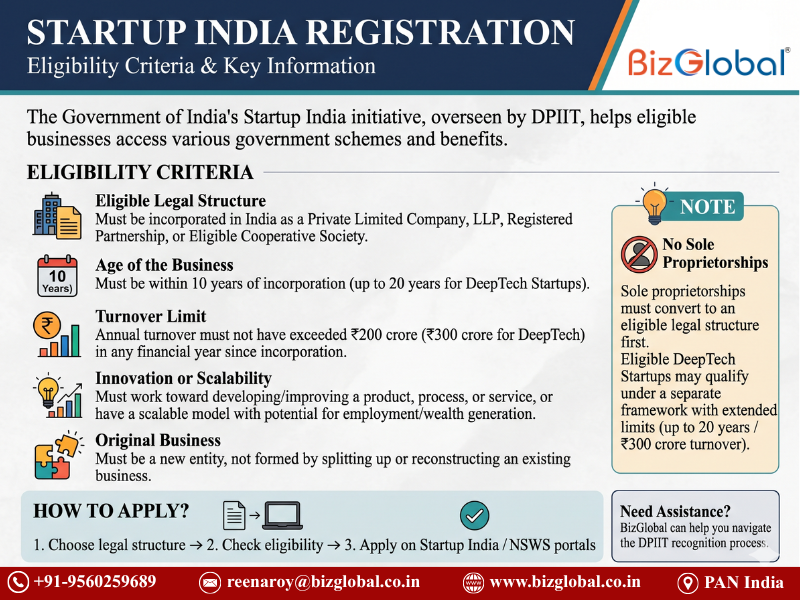
Before beginning the application, check whether your business meets the applicable eligibility requirements; which are as follows:
- Eligible Legal Structure: It must be incorporated or registered in India as a Private Limited Company, Limited Liability Partnership (LLP), registered Partnership Firm or eligible Cooperative Society.
- Age of the Business: A non-DeepTech Startup must generally be within 10 years from its incorporation or registration.
- Turnover Limit: Its turnover must not have exceeded ₹200 crore in any financial year since incorporation.
- Innovation or Scalability: It should work towards developing or improving a product, process or service, or have a scalable business model with significant potential for employment generation or wealth creation.
- Original Business: It must not have been formed by splitting up or reconstructing an existing business.
Eligible DeepTech Startups may qualify under a separate framework with an existence period of up to 20 years and a turnover threshold of ₹300 crore, subject to the applicable conditions.
A sole proprietorship cannot directly obtain DPIIT recognition in its existing form. Founders may need to consider an eligible legal structure before applying.
Is Startup India Registration Necessary for Every Business?
No. DPIIT recognition is primarily intended for businesses that meet the prescribed innovation, improvement or scalability criteria. A conventional business without a qualifying innovation or scalable model may not be eligible.
Furthermore, recognition involves documentation and continuing attention to applicable conditions. Founders should assess whether the available benefits and opportunities are relevant to their business objectives before applying.
Get Professional Guidance for Startup India Registration
Startup India registration can be an important step for eligible businesses looking to explore government support and growth opportunities. However, choosing the correct legal structure, establishing eligibility and preparing a clear application are essential to the process.
BizGlobal can help you review your eligibility, understand the documentation requirements and navigate the application process, subject to the services offered. Before proceeding, confirm the latest requirements on the official Startup India and NSWS portals.
Disclaimer: Eligibility conditions, scheme benefits and application requirements may change. Verify the latest official guidelines before applying.