
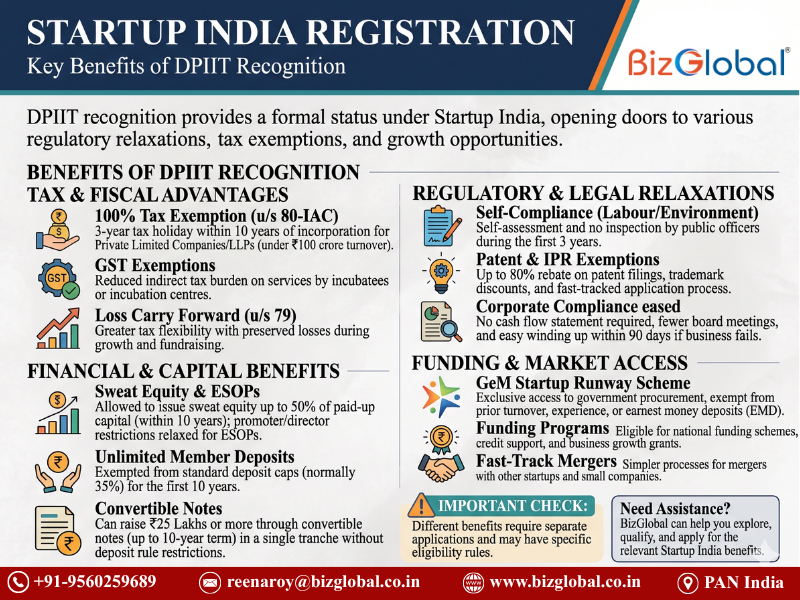
Obtaining DPIIT Startup Recognition can be an important milestone for an eligible business. It provides a formal recognition status under the Government of India's Startup India initiative and can help the business explore government-backed programmes, compliance-related relaxations and other opportunities.
However, one common misconception is that receiving a DPIIT recognition certificate automatically grants every Startup India benefit. In practice, different benefits have different eligibility requirements, application procedures and approval conditions.
Understanding Startup India benefits after DPIIT recognition helps founders, directors and finance professionals distinguish between the recognition certificate itself and the individual benefits their business may be eligible to access. This guide explains the main categories of benefits and the checks businesses should complete before relying on them.
What Are the Benefits of Startup India Registration?
DPIIT recognition can open doors to several opportunities. However, benefits are subject to the relevant laws, scheme guidelines and separate approval requirements.
1. Relaxation under Companies Act, 2013
A recognized Startup is not required to include cash flow statement with financial statements; can hold one board meeting in each half of a calendar year with a gap between two meetings of not less than 90 days; and its Annual Return can be signed by director of the company.
2. Issue of Sweat Equity Shares
Unlisted companies may issue sweat equity shares to the extent of 25% of the paid up capital at any time, with other restrictions.
But a recognized startup may issue sweat equity shares not exceeding 50% of the paid up capital up to ten years from the date of its incorporation or registration.
3. Employee Stock Option Scheme
In general, Employee Stock Options (ESOPs) are not given to the employee who is a promoter or a person belonging to the promoter group and a director who either himself or through his relative or through any body corporate, directly or indirectly holds more than 10% of the equity of the company.
But in case of a startup such condition shall not apply up to ten years from the date of incorporation. Further, the deduction in respect of income arising from the ESOP shall be deferred.
4. Convertible Notes
Startups can receive an amount of Rs 25 lakh or more by way of a convertible note (convertible into equity shares or repayable within a period not exceeding ten years from the date of issue) in a single tranche, from a person, and such transactions are not considered deposit under Deposit Rules.
5. Deposits
Companies may ordinarily accept or renew any deposits from its members not exceeding 35% of the paid-up share capital, free reserves and securities premium account of the company.
But a startup may accept deposits without any limit from its members for the period of ten years from the date of incorporation.
6. 100% Tax exemption on Profits u/s 80 IAC
Post getting recognition under startup India scheme, you may apply for Tax exemption u/s 80 IAC of the Income Tax Act.
A Startup can avail tax holiday for 3 successive financial years during its first 10 years of startup eligibility.
Criteria for applying to 80IAC Tax exemption :
- Must be a recognized Startup
- Only Private Limited or LLP is eligible
- Must be incorporated on or after 1st April, 2016
7. Relaxation in Carry Forward & Set-Off of Losses u/s 91
This allows eligible start-ups to preserve and utilise their accumulated losses despite certain changes in shareholding, subject to prescribed conditions, thereby providing greater tax flexibility during their initial growth and fundraising stages.
8. GST Exemption on Services Provided by an Incubatee
Services provided by an incubatee to an eligible incubator are exempt from GST, subject to the prescribed conditions under the GST exemption notification. This benefit reduces the indirect tax burden on eligible start-ups and incubatees, helping them manage costs during their early-stage development and incubation period.
9. GST Exemption for Services Provided by Incubation Centres
Taxable services provided by Technology Business Incubators (TBIs), Science and Technology Entrepreneurship Parks (STEPs), or Bioincubators are eligible for GST exemption, subject to prescribed conditions. This benefit helps reduce the tax burden on start-ups using incubation facilities and supports innovation, entrepreneurship and early-stage business development.
10. Self-Compliance for Labour Laws
Startups can do self assessment for labour law compliances and there will be no inspection or physical visit by public officers during the first 3 years.
11. Trademark, Patent, IPR related exemption
Recognised startups can avail following reliefs in IPR:
- Fast-track startup patent applications with 80% government fees rebate.
- Panel of facilitators to assist in IP applications
- Rebate on Filing of Trademark application
- Facility of expedited processing of patent applications
12. Easy Winding Up of Company
Startups registered under startup India scheme can avail easy exit route for winding up the company within 90 days under Insolvency & Bankruptcy Code, 2016, in case startup business model failed.
13. Funding Opportunities & Other Government Schemes
Startups registered under Startup India scheme can avail funding under various government or semi government aided schemes.
14. Easier Norms on GeM Portal
A registered startup can enjoy privileges over others private sellers. Separate scheme launched for startup named GeM Startup Runway Scheme.
On Gem Startup Runway scheme, Startups are entitled to avail exemption on:
- Prior Turnover
- Prior Experience
- Earnest Money Deposit
- Minimum criteria for govt. Tender
15. Access to National Funding Schemes & Initiatives
Startups can access national funding schemes and government-backed initiatives designed to facilitate finance, credit support and business growth, subject to applicable eligibility criteria and scheme-specific conditions.
16. Mergers
Extended fast-track process of mergers to include mergers of startups with other startups and small companies.
17. State/Union Territory Incentives
Various States and Union Territories have also harmonized the definition of startups with the Central Government and the same is used to provide benefits under regional schemes for startups.
Get Professional Guidance on Startup India Benefits
The benefits relevant to one startup may differ from those available to another. A company planning to claim a tax deduction may need a different eligibility review from a startup exploring government procurement or funding programmes.
BizGlobal can be approached to discuss your startup's recognition-related requirements and identify questions to review when exploring relevant benefits, subject to confirmation of the services offered. For tax-specific eligibility, legal interpretation or claims, consult a qualified professional where appropriate.
Before applying for any benefit, verify the current scheme guidelines, supporting-document requirements, deadlines and approval process through the relevant official portal or authority.
For more information, read our related articles on Startup India Registration: Eligibility Criteria