
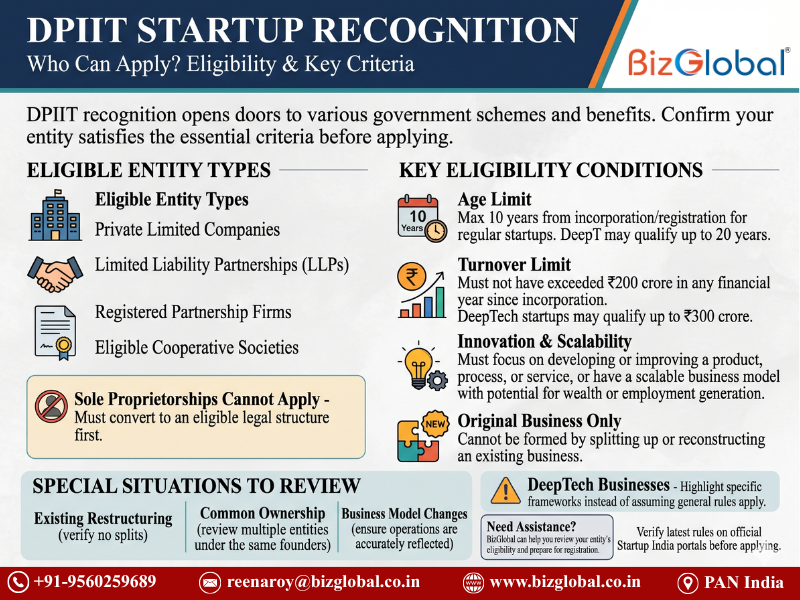
Before applying for Startup India registration, founders and directors should first determine whether their business meets the eligibility conditions prescribed by the Department for Promotion of Industry and Internal Trade (DPIIT). Obtaining recognition can open doors to various government schemes, compliance-related relaxations and business development opportunities. However, not every newly established business automatically qualifies.
Understanding DPIIT recognition eligibility helps businesses assess their legal structure, age, turnover and innovation criteria before beginning the application process. This guide explains who can apply, which conditions must be satisfied and what founders should review before submitting an application.
Which Entities are eligible for DPIIT Recognition?
The legal structure of a business is one of the first conditions to examine. Under the applicable framework, eligible startup entities in India generally include:
- Private Limited Companies
- Limited Liability Partnerships (LLPs)
- Registered Partnership Firms
- Eligible Cooperative Societies
A sole proprietorship cannot directly obtain DPIIT recognition in its existing form. A founder operating as a sole proprietor may need to consider an eligible legal structure before applying.
Choosing an appropriate entity type should also involve reviewing ownership, liability, funding plans, compliance requirements and long-term business objectives. Conversion or restructuring should not be undertaken solely on the assumption that recognition will be granted automatically.
What is the Startup Age Limit?
The age of the business is another important part of the DPIIT startup eligibility criteria.
Generally, a startup must not have exceeded 10 years from its date of incorporation or registration to qualify under the regular framework.
Eligible DeepTech startups may qualify under a separate framework allowing an existence period of up to 20 years, subject to the applicable conditions.
Founders should verify the incorporation or registration date from the relevant certificate before applying. The age requirement is not determined simply by when the business launched its website, introduced a product or started generating revenue.
What is the Startup Turnover Limit?
The turnover threshold helps determine whether a business falls within the applicable startup recognition framework.
Under the general criteria, a startup's turnover must not have exceeded ₹200 crore in any financial year since incorporation.
Eligible DeepTech startups may qualify under a separate framework with a turnover threshold of ₹300 crore, subject to the prescribed conditions.
What are the Innovative Startup Criteria?
Innovation and scalability are central to the recognition framework. A business should be working towards developing or improving a product, process or service, or have a scalable business model with significant potential for wealth creation or employment generation.
This means that founders should be able to explain what their business does, which problem it addresses and how its approach contributes to innovation, improvement or scalability.
Must the Startup be a New Business?
The recognition framework also requires that the entity must not have been formed by splitting up or reconstructing an existing business.
This condition is important for founders who have created a new legal entity from an existing operation. Where ownership or business arrangements are complex, an eligibility review can help identify issues that should be clarified before the application is filed.
Special Situations Founders Should Review
Some businesses may need additional scrutiny before applying. Consider the following situations:
- Existing Business Restructuring: If the entity was created by splitting or reconstructing an existing business, review whether it satisfies the applicable conditions.
- DeepTech Businesses: A startup working in advanced science or technology should verify whether it meets the specific DeepTech framework rather than assuming that a longer age limit automatically applies.
- Multiple Entities under Common Ownership: Where founders have other businesses, subsidiaries or related entities, the ownership and structure should be checked against the current recognition rules.
- Business Model Changes: If the business has changed its activities, products or structure, ensure the application accurately reflects its current operations.
The official recognition portal and applicable DPIIT notifications should be consulted for the complete conditions, including any additional restrictions or requirements.
Review Your Entity's Eligibility Before Applying
DPIIT recognition can be valuable for eligible businesses, but the first step is confirming that the entity satisfies the applicable conditions. Reviewing the legal structure, incorporation date, turnover history and innovation criteria can help founders identify potential issues before applying.
BizGlobal can help you review your entity's eligibility and understand the documentation and application requirements, subject to confirmation of the services offered. The objective is to help you understand your position before proceeding with the recognition application.
Explore our related guides on Startup India Registration: Eligibility Criteria, Startup India Registration: Documents Required & Application Process and Startup India Benefits After DPIIT Recognition: 17 Key Benefits.
Disclaimer: Eligibility requirements may change through government notifications. Verify the latest criteria on the official Startup India recognition portal before applying.