
Once you have determined that your business may qualify for Startup India recognition, the next step is to prepare the necessary documents and complete the application correctly. Missing information, inconsistent entity details or an unclear description of the business can lead to avoidable queries during the process.
This guide covers the documents and information founders should prepare, the general application sequence and practical checks to complete before submitting the application for DPIIT recognition.
Why Is Document Preparation Important?
Preparing documents in advance makes it easier to complete the online application accurately. It also gives founders an opportunity to check whether the details entered in the application match the entity's official records.
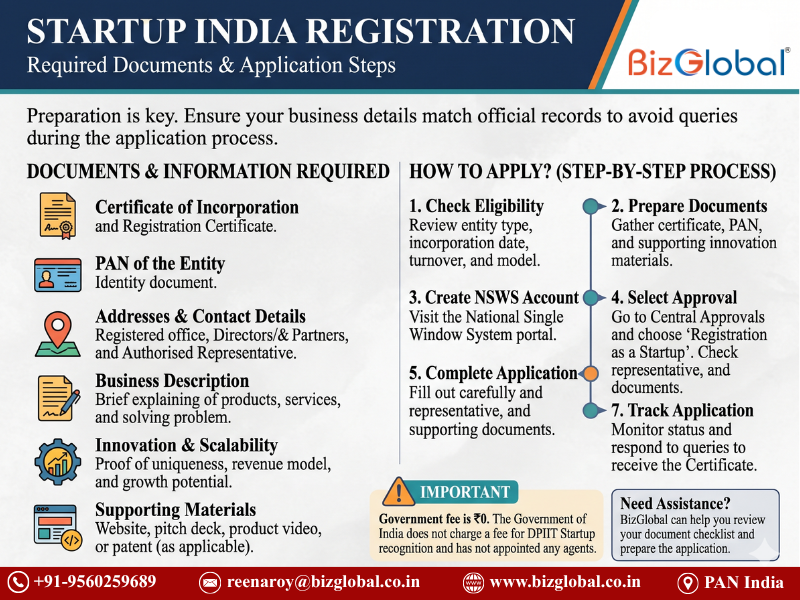
Documents Required for Startup India Registration
Preparing the required information in advance can make the application process easier. The documents and details generally include:
- Certificate of Incorporation or Registration Certificate.
- PAN of the Entity.
- Registered office address and business details.
- Names and contact details of Directors, Partners or Designated Partners, as applicable.
- Details of the Authorised Representative.
- A brief description of the business, products or services.
- Information explaining the innovation, improvement or scalability of the business model.
- Details of the revenue model and product or service uniqueness.
- Supporting material such as a website, pitch deck, product video or patent, as applicable.
The exact information required may vary depending on the nature of the entity and the application. Ensure that the business description clearly explains the problem being solved, the proposed solution and how the business differs from existing alternatives.
How to Apply for Startup India Registration?
The application for DPIIT recognition is submitted through the National Single Window System (NSWS). The general process involves the following steps.
Step 1: Check eligibility. Review your entity type, incorporation date, turnover and business model against the applicable recognition criteria.
Step 2: Prepare your documents. Keep the incorporation or registration certificate, PAN, entity details and supporting information about your product, service or innovation ready.
Step 3: Create an account on NSWS. Visit the official National Single Window System portal and create an account using the required details.
Step 4: Select the relevant approval. Under the Central Approvals section, select “Registration as a Startup” and proceed with the application.
Step 5: Complete the application. Enter the required details about your entity, authorised representative, business activities and innovation or scalability.
Step 6: Review and submit. Check the application carefully and submit the required information and supporting documents.
Step 7: Track the application. Monitor the application status and respond to any request for additional information, if applicable. If the application is approved, the entity can obtain its DPIIT recognition certificate.
The Government does not charge a fee for DPIIT Startup recognition. It has also clarified that it has not appointed agents or representatives to undertake recognition applications on its behalf.
Get Professional Guidance for Startup India Registration
Preparing an application requires attention to both documentation and the way the business is described. Before submitting, founders should check that the entity details are accurate, the supporting information is relevant and the business description clearly explains the applicable innovation or scalability criteria.
BizGlobal can be approached to discuss your document checklist and application-preparation requirements, subject to confirmation of the services offered. A review before submission can help identify missing information or inconsistencies that may need attention.
For more information, read our related articles on Startup India registration eligibility criteria and benefits available after DPIIT recognition.