
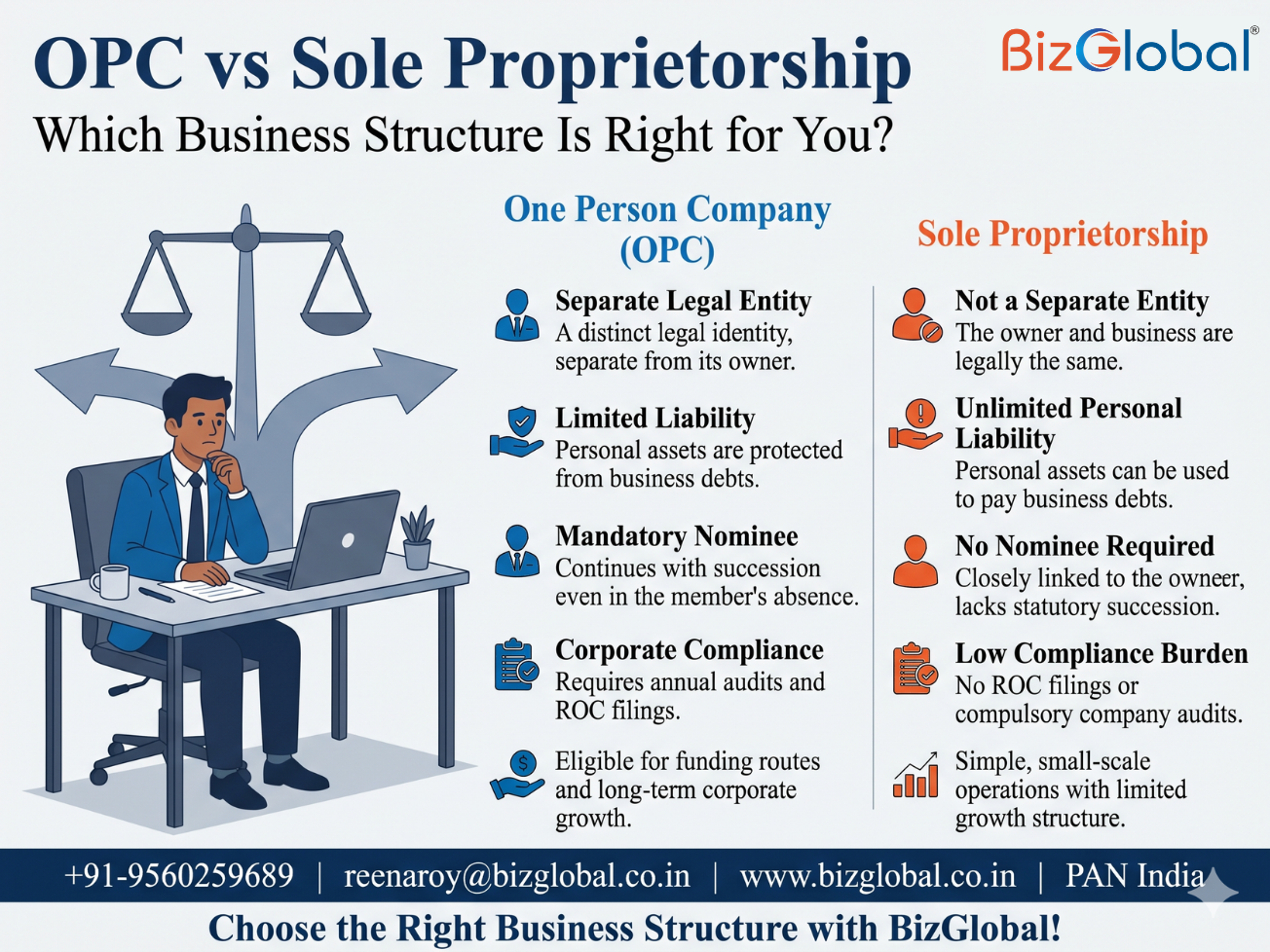
Starting a business alone does not mean you have to operate it under only one type of business structure. In India, an individual entrepreneur can choose to operate through a sole proprietorship or incorporate a One Person Company (OPC).
Both structures allow a single individual to own and control a business. However, their legal identity, liability, taxation, compliance requirements and long-term growth opportunities are quite different.
So, when comparing OPC vs sole proprietorship, which structure should an individual business owner choose?
A. What Is a Sole Proprietorship?
A sole proprietorship is a business owned, managed and controlled by one individual. The owner and the business are not separate legal persons.
The proprietor makes business decisions, receives the profits and is personally responsible for the business's obligations and liabilities.
There is no single central incorporation process for creating a sole proprietorship. However, the business may need registrations, licences and tax-related registrations depending on its activities and applicable laws.
For example, an individual running a small consultancy, local retail shop or independent service business may choose to operate as a sole proprietor.
B. What Is a One Person Company (OPC)?
A One Person Company is a company incorporated under the Companies Act, 2013 with only one person as its member.
Section 2(62) of the Companies Act, 2013 defines an OPC as a company having only one person as a member.
Unlike a sole proprietorship, an OPC has a separate legal identity from its member. It can own property, enter into contracts, open bank accounts and undertake business activities in its own name.
An OPC also has the feature of limited liability, subject to the applicable legal exceptions. It must have a nominee who may become its member in the circumstances prescribed under Section 3(1) of the Act.
For an individual entrepreneur who wants a formal corporate structure while retaining single-member ownership, an OPC can be a suitable option.
OPC vs Sole Proprietorship: Key Differences
The following table explains the major differences between the two business structures.
|
Basis of Comparison |
OPC |
Sole Proprietorship |
|
Legal status |
Separate legal entity |
Not separate from its owner |
|
Governing framework |
Companies Act, 2013 and applicable rules |
Applicable business, tax and sector-specific laws |
|
Ownership |
One member |
One proprietor |
|
Liability |
Generally limited to the member's liability in the company, subject to exceptions |
Unlimited personal liability |
|
Incorporation |
Formal incorporation with MCA |
No separate incorporation under the Companies Act |
|
Nominee |
Mandatory |
Not required under any law |
|
Management |
Managed through its director or directors |
Directly managed by the proprietor |
|
Compliance |
Corporate and other applicable compliances |
Business-specific and tax-related compliances |
|
Statutory audit |
Mandatory under company law |
Depends on applicable tax and other audit provisions |
|
Annual ROC filings |
Applicable |
Not applicable |
|
Business continuity |
Separate legal existence with statutory membership succession |
Closely linked to the proprietor |
|
Funding |
Can access eligible company funding routes, subject to legal restrictions |
Funding generally depends on proprietor's resources and lender arrangements |
|
Conversion |
Can convert into another permitted company structure by following applicable procedures |
May restructure or transfer the business, subject to applicable laws |
Practical example:
Suppose an individual operates a business that enters into significant supply contracts and takes commercial credit.
If the business is a sole proprietorship, the proprietor may be personally liable for the business obligations.
If the business operates through an OPC, the company is ordinarily responsible for its contractual obligations. The member's personal liability is generally limited, subject to the applicable exceptions and any personal guarantees given.
For businesses involving substantial contractual or financial risks, this distinction deserves careful consideration.
Can a Sole Proprietorship Be Converted Into an OPC?
A sole proprietorship and an OPC are legally different structures. A sole proprietorship does not automatically become an OPC simply because the proprietor decides to incorporate a company.
The proprietor may establish a new OPC and subsequently transfer or restructure the business, subject to applicable legal, contractual, tax and regulatory requirements.
This may involve reviewing:
- Transfer of business assets and liabilities.
- Existing contracts and customer arrangements.
- Intellectual property ownership.
- GST and other registrations.
- Employee-related obligations.
- Tax implications of the transfer.
- Licences and approvals that may need fresh applications or amendments.
The appropriate method depends on the facts of the business. Professional advice is recommended before transferring an existing business into a company.
How BizGlobal Can Help?
Choosing between an OPC and a sole proprietorship is an important business decision. The right structure should reflect the entrepreneur's commercial objectives, expected growth, liability exposure and willingness to manage statutory compliance.
BizGlobal can assist individual entrepreneurs with understanding the procedural requirements of different business structures and evaluating incorporation-related documentation and compliance considerations.