
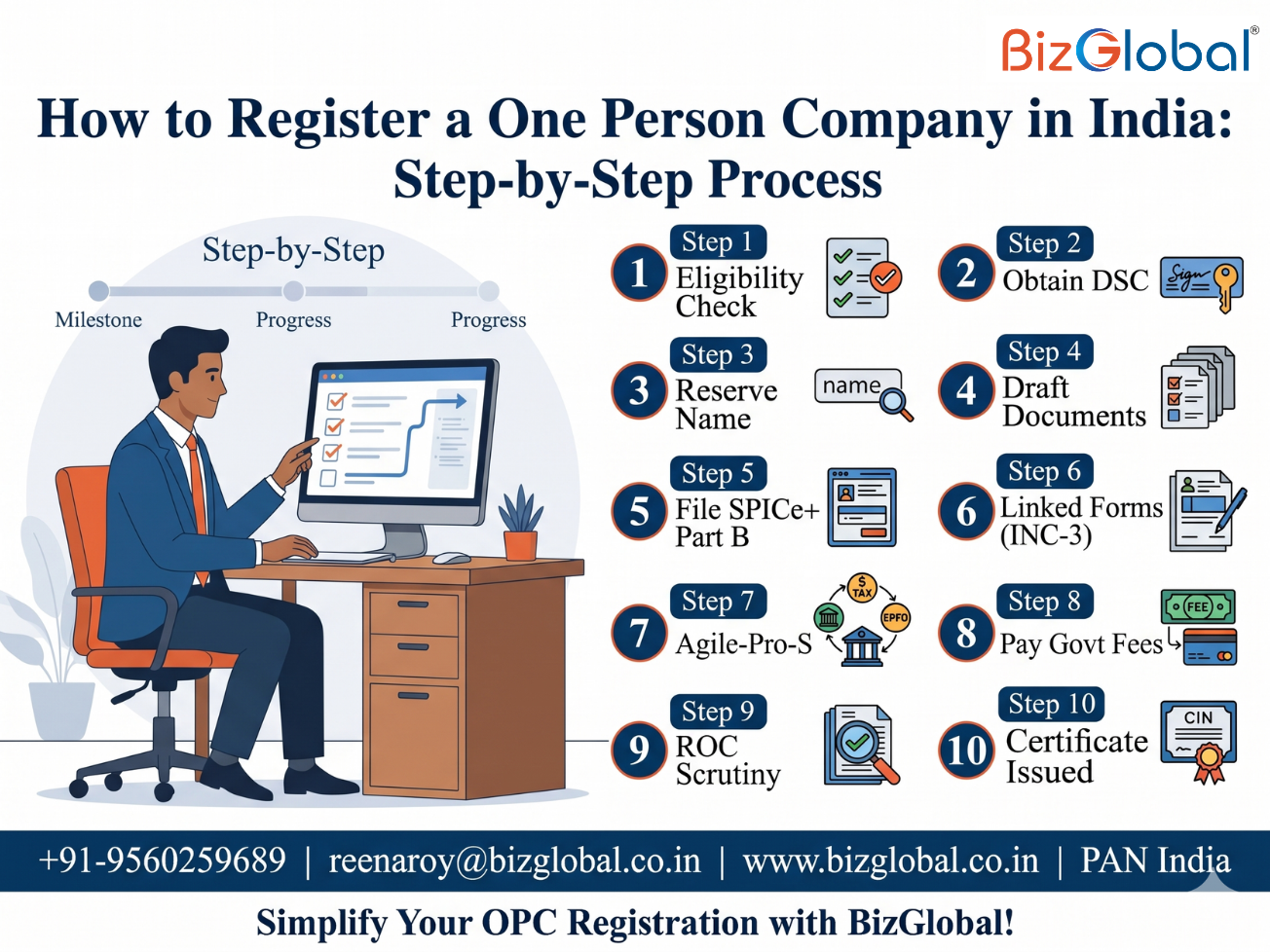
Planning to start a business independently? If you want to operate through a formal company structure without bringing in another shareholder, a One Person Company (OPC) may be worth considering.
However, understanding the business structure is only the beginning. The next question is how to actually register it.
Section 3(1)(c) permits one person to form an OPC by subscribing to the memorandum and complying with the applicable incorporation requirements.
Step-by-Step OPC Incorporation Process in India
Step 1: Check OPC Eligibility
Before starting the incorporation process, check whether the proposed member meets the applicable OPC eligibility requirements.
It is advisable to complete this eligibility review before proceeding with name reservation.
For a detailed explanation, read our article: Who Can Register a One Person Company in India? OPC Eligibility Explained.
Step 2: Obtain Digital Signature Certificates (DSCs)
A DSC is used to authenticate electronic documents and forms filed with the MCA.
The proposed member, first director and nominee may require DSCs depending on their roles and the applicable filing requirements.
Step 3: Select and Reserve the Company Name
Choosing a suitable company name is another important step.
The proposed name must comply with the Companies Act, 2013 and the Companies (Incorporation) Rules, 2014.
The name should not be identical or too similar to an existing company's name or registered trademark in circumstances prohibited by the applicable rules.
The applicant can use SPICe+ Part A on the MCA portal to apply for name reservation.
An OPC is a private company, and its name ordinarily ends with the words "OPC Private Limited".
Step 4: Prepare the Incorporation Documents
Once the proposed name is approved, the next step is to prepare the documents and information required for incorporation.
The exact attachments depend on the applicant's circumstances and the current MCA form requirements.
To know more about the documents and information required for incorporation, read our article on Documents Required for One Person Company Registration in India.
Step 5: File SPICe+ Part B
SPICe+ Part B is the principal incorporation form.
It captures important details relating to the proposed company, including:
- Proposed company name.
- Registered office and correspondence details.
- Capital structure.
- Details of the subscriber and proposed director.
- Business activity and NIC code.
- Details required for DIN allotment, where applicable.
- PAN and TAN application details.
SPICe+ Part B also facilitates certain integrated services, making the incorporation process more streamlined.
The information entered should be consistent with the supporting documents and constitutional documents.
Step 6: File the Linked Incorporation Forms
Along with SPICe+ Part B, certain linked forms must be completed and submitted, as applicable.
The important forms include:
|
Form |
Purpose |
|
INC-3 |
Nominee's consent to act as nominee |
|
INC-33 |
Electronic Memorandum of Association (e-MOA) |
|
INC-34 |
Electronic Articles of Association (e-AOA) |
|
INC-35 |
AGILE-PRO-S for linked registrations |
|
INC-9 |
Declaration by subscribers and first directors, where applicable |
The linked forms must be completed in accordance with the MCA filing sequence and applicable requirements.
Step 7: Complete AGILE-PRO-S and Other Applicable Registrations
AGILE-PRO-S is a linked form used for various registrations and services associated with company incorporation.
Depending on the applicable requirements and selections, it facilitates:
- GST registration, where opted for.
- EPFO registration.
- ESIC registration.
- Professional Tax registration in applicable states.
- Bank account opening request.
- Delhi Shops and Establishment registration, where applicable.
Step 8: Submit the Forms and Pay Applicable Fees
After completing the forms and obtaining the necessary digital signatures, the incorporation application is submitted through the MCA portal.
The applicant must pay the applicable statutory fees and stamp duty.
Step 9: Verification by the Registrar of Companies
After submission, the application is processed through the MCA's designated incorporation processing mechanism.
The application and supporting information are examined for compliance with the applicable legal and procedural requirements.
If clarification or resubmission is required, the applicant must address the observations within the prescribed period.
It is important to understand that filing the forms does not automatically guarantee approval. The application remains subject to scrutiny by the competent authority.
Step 10: Receive the Certificate of Incorporation
Once the incorporation application is approved, the Registrar of Companies (ROC) issues the Certificate of Incorporation.
The certificate confirms the legal incorporation of the OPC.
How BizGlobal Can Help?
Incorporating a company involves more than filling out an online application. Entrepreneurs must understand the applicable legal requirements, prepare appropriate documentation and ensure that the information submitted through the MCA portal is consistent.
BizGlobal can assist entrepreneurs with understanding OPC incorporation requirements, organising the necessary documentation and navigating the applicable incorporation procedures.