
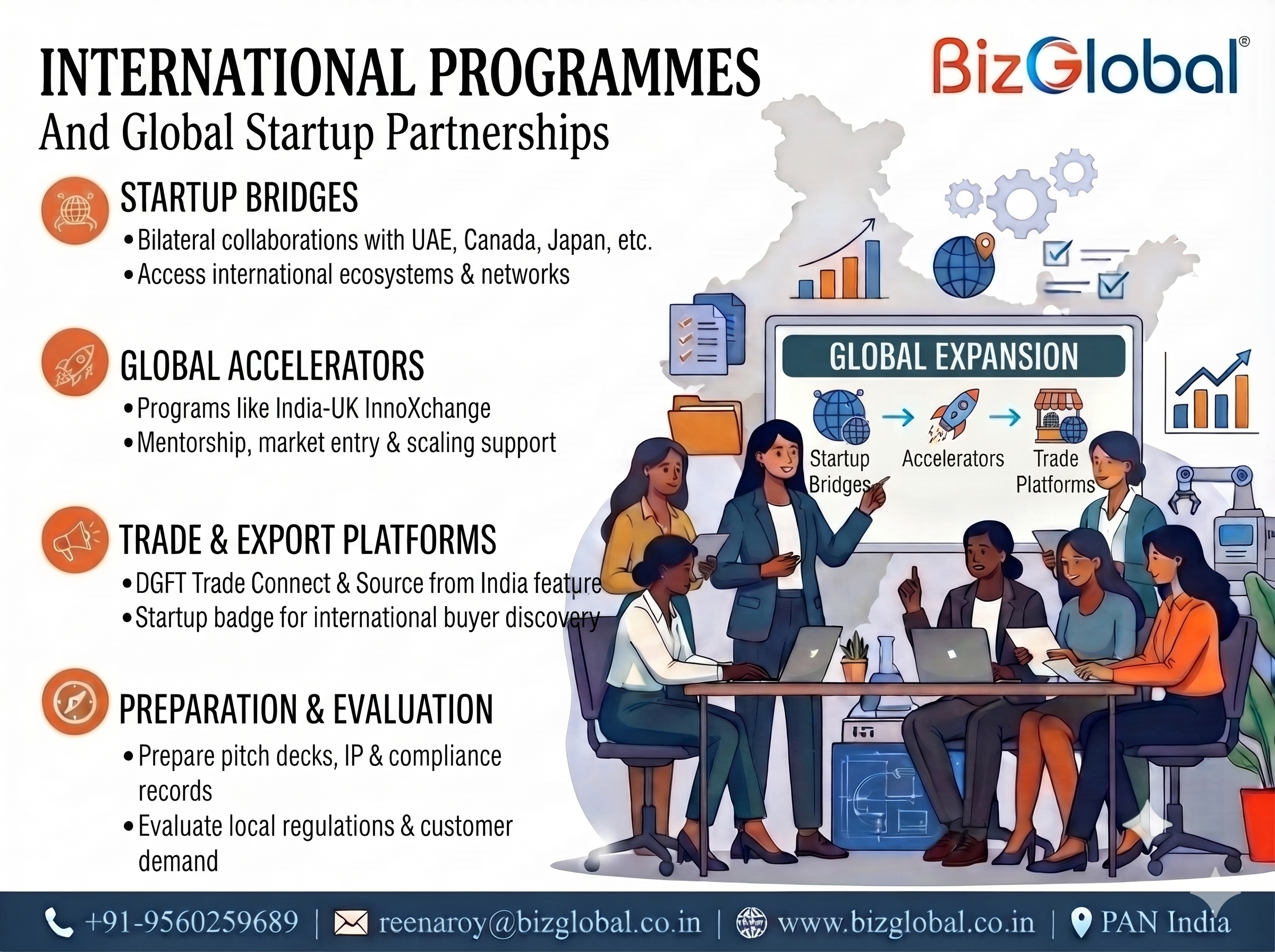
Expanding beyond India can help startups access new customers, investors, technology partners and international markets. However, entering another country requires more than a promising product. Founders must understand local regulations, customer expectations, pricing, competition and the business environment.
The good news is that Indian startups can explore several international programmes, government-led collaborations and global accelerator opportunities that support cross-border connections.
This article explains where founders can look for these opportunities and how to prepare before applying.
Explore Startup India's Global Collaborations
Startup India facilitates international ecosystem connections through bilateral collaborations, commonly known as Startup Bridges.
These collaborations aim to connect Indian startups with overseas startups, investors, incubators, accelerators and other ecosystem participants. They may provide knowledge exchange, networking, startup exposure, innovation challenges and opportunities to explore partnerships.
The Startup India international portal lists collaborations involving countries such as the UAE, Canada, Japan, Singapore, Israel, the UK, Finland, Brazil and others.
For founders, these platforms can be useful starting points to:
- Understand the startup ecosystem in a target country.
- Identify potential international partners and investors.
- Explore startup exchange programmes and innovation challenges.
- Connect with incubators and accelerators.
- Learn about possible market-entry opportunities.
However, a Startup Bridge should not be treated as a guaranteed funding or overseas-incorporation programme. Check the individual collaboration page for active opportunities, eligibility and application timelines.
Look for International Accelerators and Exchange Programmes
International accelerators help startups understand overseas markets through mentorship, networking, business development and exposure to potential customers.
Some programmes are sector-specific, while others focus on technology, research, innovation or market entry.
For example, the India-UK InnoXchange Programme was a bilateral initiative involving India's Department of Science and Technology and Innovate UK. It aimed to connect technology-led startups, incubators, universities and research institutions for collaboration, joint development and international market access.
Its 2026 application deadline was 17 July 2026, so founders should check for future cohorts rather than assume applications remain open.
Startups can also explore private and corporate accelerator programmes, including those run by global technology companies. Their eligibility may depend on the startup's stage, sector, technology and business model.
Use Government Platforms to Discover Global Market Opportunities
International expansion is not limited to accelerator participation. Government trade platforms can also help startups become visible to overseas buyers.
An important development is the Source from India feature on the DGFT Trade Connect ePlatform.
In August 2026, the Directorate General of Foreign Trade expanded eligibility for this service to include eligible DPIIT-recognised startups. The initiative provides a dedicated startup badge on the buyer-discovery platform, helping international buyers identify innovative Indian businesses and explore their products and capabilities.
Startups interested in exports should also explore relevant export-promotion bodies, sector-specific export councils and trade facilitation resources.
For example, an agri-tech startup may need a different export-support ecosystem from a software or manufacturing startup.
How to Identify the Right International Programme?
Do not apply to every global programme simply because it offers international exposure. First, identify the business objective.
|
Business objective |
Programme to explore |
|
Understand an overseas market |
Startup Bridges and market-entry programmes |
|
Find international investors |
Investor networking and global pitch events |
|
Build technology partnerships |
Research collaborations and innovation exchanges |
|
Meet potential customers |
Trade platforms, exhibitions and buyer-seller programmes |
|
Improve business readiness |
International accelerators and mentoring |
|
Explore exports |
DGFT resources and sector-specific export bodies |
Check the programme's official website for eligibility, application dates, costs, selection criteria and the support actually offered.
Prepare Your Startup Before Applying
International programmes can be competitive. Founders should prepare a clear business proposition before approaching overseas partners.
Keep the following ready:
- Company incorporation and ownership details.
- DPIIT recognition certificate, if applicable.
- A concise company profile and pitch deck.
- Product demonstration or working prototype.
- Revenue model, traction and customer information.
- Intellectual property ownership and licensing details.
- Financial projections and expansion plan.
- Evidence of product-market fit and customer demand.
Also assess whether your product requires country-specific certifications, data protection compliance, import permissions, local licences or other regulatory approvals.
If you plan to establish an overseas subsidiary or make an overseas investment, obtain appropriate professional advice on Indian foreign exchange regulations and the laws of the destination country.
What Should Founders Evaluate Before Expanding Abroad?
International exposure does not automatically translate into international revenue.
Before committing resources, evaluate the target market's customer demand, pricing expectations, competitors, distribution channels, taxation, intellectual property protection and operating costs.
Understand whether the programme offers introductions, mentoring, market research, funding, pilot opportunities or actual customer access. These are different forms of support.
A practical approach is to begin with market research and partner discovery, validate demand through discussions or pilot projects, and then develop a market-entry plan.
Disclaimer: This article is for general informational purposes only. Programme availability, eligibility, application windows and benefits may change. Refer to the latest official programme guidelines before applying.