
DeepTech startups often require longer research and development cycles, significant capital investment and specialised infrastructure before their innovations become commercially viable. Recognising these challenges, the Government of India introduced a separate DeepTech category under the revised DPIIT startup recognition framework in February 2026.
For research-led founders, DeepTech startup DPIIT recognition can provide access to a recognition framework designed around the realities of scientific and engineering innovation.
However, a startup does not qualify merely because it uses advanced technology. It must demonstrate specific characteristics relating to scientific innovation, research expenditure, intellectual property and technical uncertainty.
What Is DeepTech Startup DPIIT Recognition?
The Department for Promotion of Industry and Internal Trade (DPIIT), under the Ministry of Commerce and Industry, recognises eligible entities under the Startup India initiative.
The revised framework, notified on 4 February 2026, introduced a dedicated DeepTech category. It acknowledges that research-intensive businesses may need more time and resources to develop, validate and commercialise their products.
The category is particularly relevant to businesses working in areas such as biotechnology, artificial intelligence, robotics, advanced materials, quantum technologies, semiconductors and other scientific or engineering disciplines, provided they satisfy the prescribed criteria.
DeepTech Startup Eligibility in India
A DeepTech applicant must first satisfy the general startup recognition conditions and then demonstrate the additional DeepTech attributes.
The key eligibility conditions include:
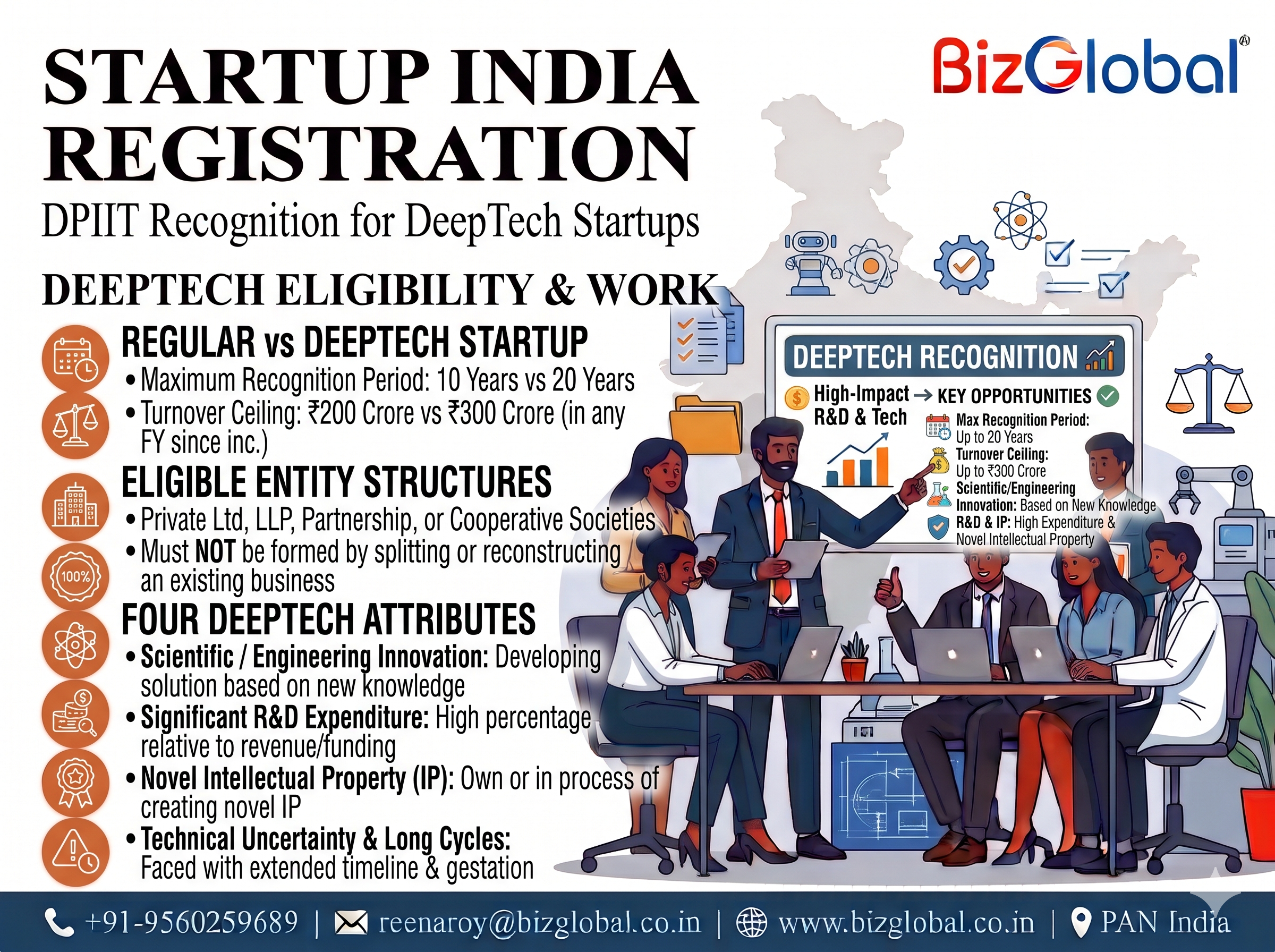
- Eligible entity structure: The entity must be incorporated or registered in India as a Private Limited Company, registered Partnership Firm, Limited Liability Partnership, Multi-State Cooperative Society or Cooperative Society.
- Age limit: The entity must be within 20 years from its incorporation or registration date.
- Turnover limit: Its turnover must not exceed ₹300 crore in any financial year since incorporation or registration.
- Innovation: It must work towards innovation, development or improvement of products, processes or services, or operate a scalable business model with high potential for employment generation or wealth creation.
- Original business: It must not have been formed by splitting up or reconstructing an existing business.
Meeting these conditions alone does not establish DeepTech eligibility. The applicant must also demonstrate the additional characteristics explained below.
What Qualifies as a DeepTech Startup?
The revised framework identifies four important attributes:
1. Scientific or engineering innovation: The startup must be developing a solution based on new knowledge or advancements in one or more scientific or engineering disciplines. The solution may still be under development.
2. Significant R&D expenditure: A high percentage of the startup's expenditure, relative to its revenue or funding, should be directed towards research and development activities.
3. Novel intellectual property: The startup should own, or be in the process of creating, significant novel intellectual property and take steps towards its commercialisation.
4. Technical uncertainty and long development cycles: The business should face factors such as extended development timelines, long gestation periods, high capital or infrastructure requirements and substantial scientific or technical uncertainty.
DPIIT determines whether these attributes are satisfied based on the prescribed framework, parameters, guidelines and documents submitted by the applicant.
DeepTech Age Limit and Turnover Limit: What Changed?
The revised framework provides higher thresholds for qualifying DeepTech startups.
|
Criteria |
Regular Startup |
DeepTech Startup |
|
Maximum recognition period |
10 years |
20 years |
|
Turnover ceiling |
₹200 crore |
₹300 crore |
The limits apply from the date of incorporation or registration and consider turnover in any financial year since incorporation or registration.
This distinction is important for research-led businesses that may take several years to move from laboratory development to commercial operations.
Documents and Application Considerations
Applicants should prepare their incorporation or registration certificate and a clear business write-up explaining the nature of their activities.
DeepTech applicants should also be prepared to provide supporting information demonstrating the four DeepTech attributes. Depending on the business, relevant evidence may include:
- Research and development expenditure records.
- Technical reports and research documentation.
- Product development and prototype details.
- Patent applications, granted patents or other IP documentation.
- Details of scientific or engineering innovation.
- Commercialisation plans and development milestones.
- Evidence of technical uncertainty and infrastructure requirements.
The precise documents and information required should be checked against the live DPIIT application form.
Applications are submitted through the National Single Window System (NSWS). DPIIT may request additional documents or information before deciding the application.
How BizGlobal Can Help?
Before applying, founders should review their entity structure, incorporation records and business documentation. BizGlobal may assist with relevant incorporation-related and startup compliance requirements, subject to confirmation of service availability and scope.
The DeepTech classification decision rests with DPIIT, and founders should submit applications using their own details and credentials.
Disclaimer: This article is for general informational purposes only and does not constitute legal, tax or professional advice. Eligibility, documentation and application requirements are subject to the latest DPIIT notifications, guidelines and portal requirements.