
Turning an innovative idea into a market-ready product requires capital. Early-stage startups often need funding to validate their concept, develop a prototype, conduct product trials or prepare for commercial launch. However, traditional lenders and investors may hesitate to finance a business before it demonstrates market potential.
The Startup India Seed Fund Scheme (SISFS) was designed to address this early-stage funding gap by providing financial assistance through eligible incubators to support eligible startups during proof-of-concept development, prototype creation, product trials, market entry and commercialisation. For founders exploring startup seed funding in India, understanding the scheme’s eligibility requirements, funding structure and application process is essential.
Before preparing an application, however, founders should check the scheme’s current status and confirm whether applications are being accepted.
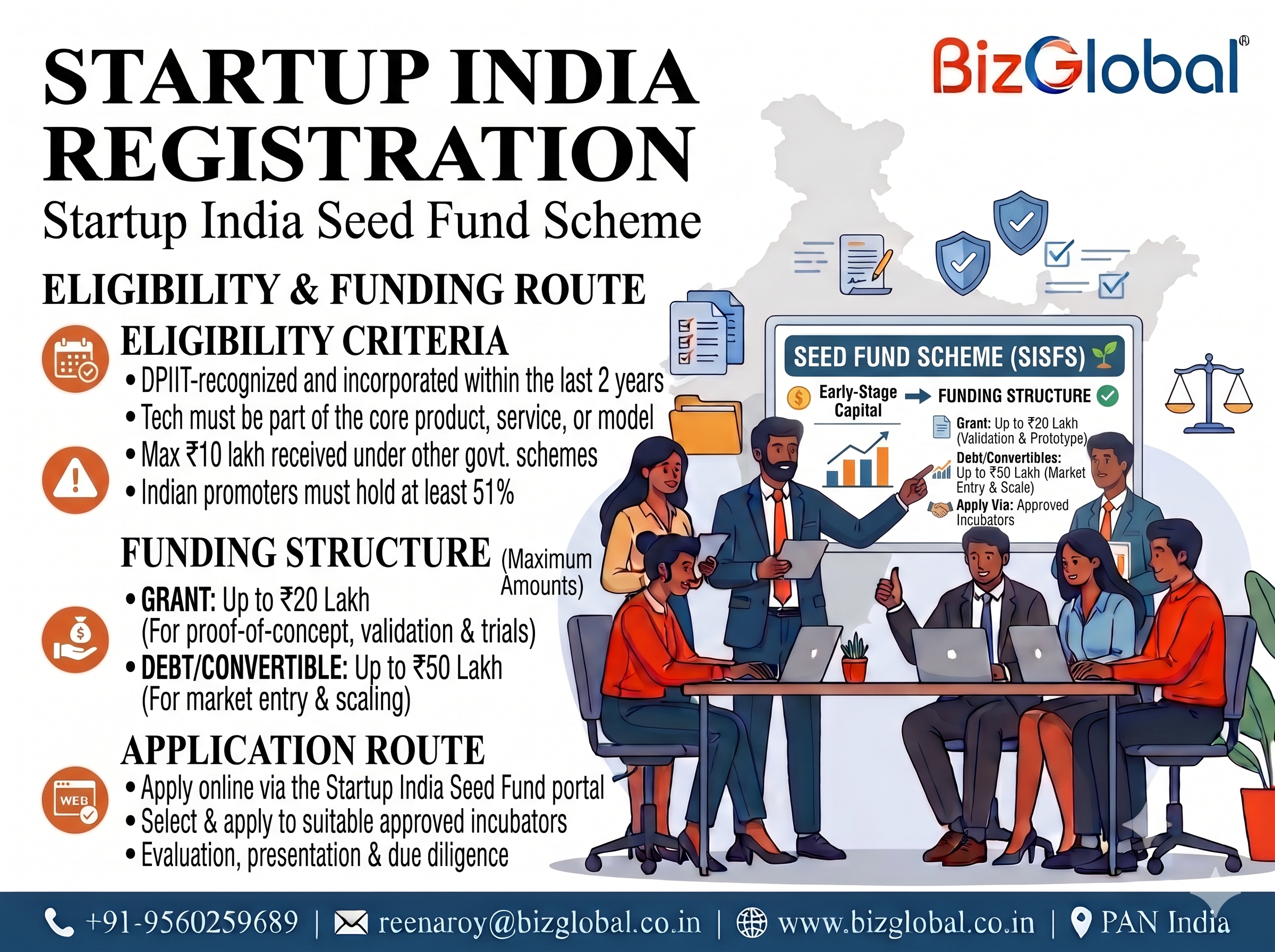
SISFS Eligibility Criteria
According to the published scheme guidelines, applicants must satisfy the applicable conditions, including the following:
- The startup must be recognised by DPIIT.
- It must have been incorporated no more than two years before applying.
- The proposal should demonstrate market fit, commercial viability and scope for scaling.
- Technology should form part of the core product, service, business model, distribution model or methodology used to solve the identified problem.
- The startup must not have received more than ₹10 lakh in monetary support under other Central or State Government schemes, subject to the exclusions specified in the guidelines.
- Indian promoters must hold at least 51% shareholding at the time of application, as specified in the scheme guidelines.
The scheme is sector-agnostic, although preference is given to innovative solutions in areas such as agriculture, healthcare, education, financial inclusion, clean energy and waste management. All applicable eligibility criteria must be satisfied on the date of application.
How Much Funding Can a Startup Receive?
The scheme provides two principal forms of assistance:
|
Funding type |
Maximum amount |
Intended purpose |
|
Grant |
Up to ₹20 lakh |
Proof-of-concept validation, prototype development and product trials |
|
Debt or convertible instruments |
Up to ₹50 lakh |
Market entry, commercialisation and scaling |
Eligible startups may receive support under each category once, subject to the scheme guidelines. The money must be used for the approved purpose; it should not be treated as unrestricted business funding.
How to Apply Through Incubators?
The application can be applied through the Startup India Seed Fund portal. The general route is:
- Confirm recognition and eligibility.
- Check whether applications are open.
- Prepare the proposal.
- Select suitable incubators.
- Submit the application online.
- Participate in evaluation.
- Complete due diligence and documentation.
Get Professional Guidance for Startup Funding Applications
Before pursuing seed funding, founders should review their DPIIT recognition, incorporation records, shareholding, proposed milestones and financial requirements. The application should clearly explain why funding is needed and how it will advance the business.
BizGlobal may be considered for relevant startup compliance or documentation support, subject to confirmation of service availability and the specific requirements involved. Scheme selection and funding decisions remain with the authorised incubators and relevant authorities.
Disclaimer: This article is for general informational purposes only. Scheme terms and availability may change. Always verify the latest official guidelines before taking action.