
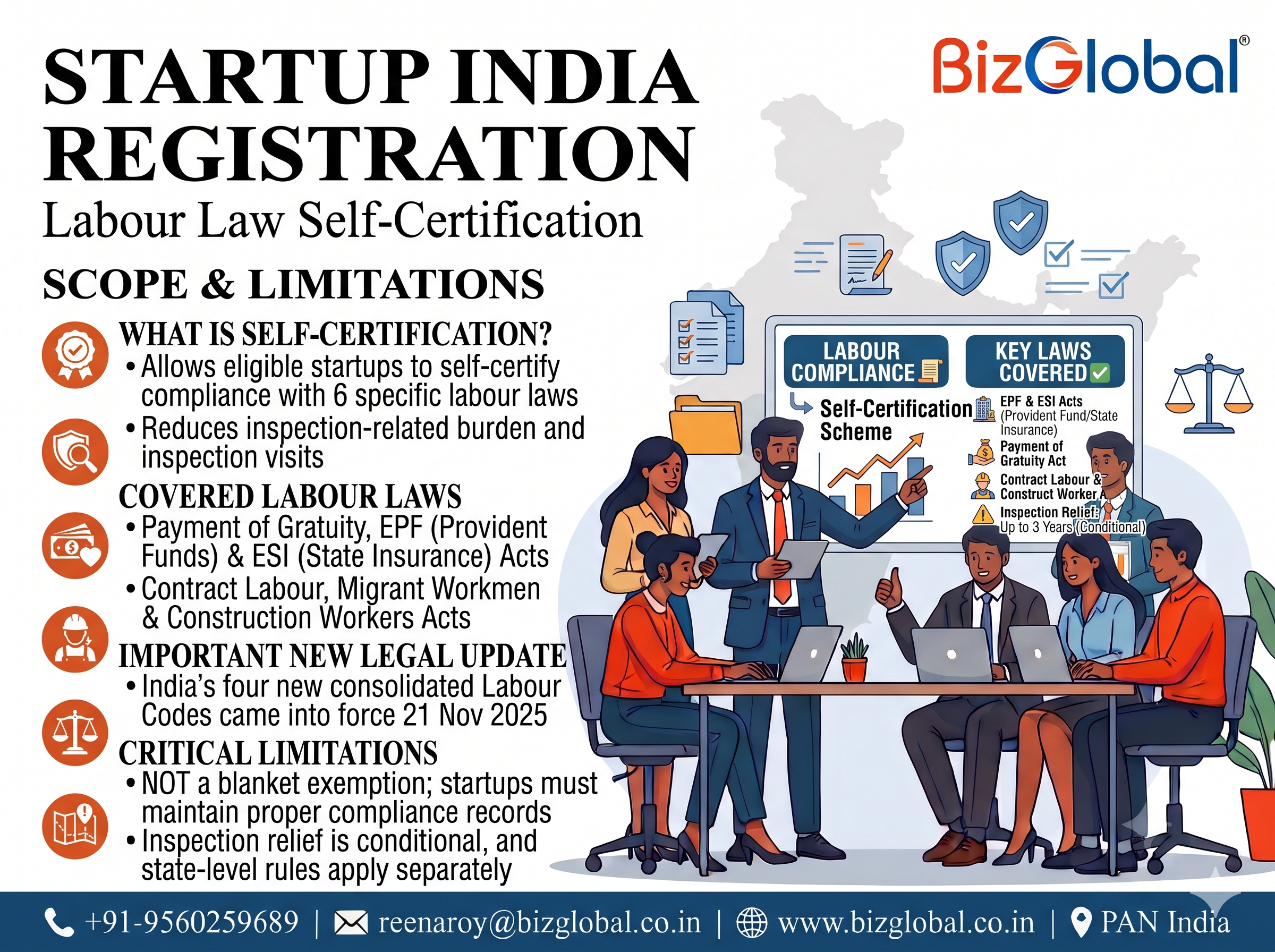
Hiring employees is an important milestone for any startup, but it also brings legal responsibilities. From social security contributions to employee welfare and workplace conditions, founders must understand which labour laws apply to their business. To reduce the regulatory burden on eligible startups, the Government of India introduced a self-certification framework under the Startup India initiative.
For founders, HR teams and compliance professionals, understanding the scheme’s scope and limitations is essential to building a compliant workforce while avoiding unnecessary legal risks.
What Is the Startup Self-Certification Scheme?
The Startup India initiative introduced a compliance framework allowing eligible startups to self-certify compliance with specified labour laws. The objective is to reduce unnecessary inspection-related burdens and encourage startups to maintain proper compliance records.
Startups should confirm the current process and eligibility requirements applicable to their establishment rather than assuming that DPIIT recognition alone automatically activates every relaxation.
Which Labour Laws Are Covered?
The Startup India scheme identifies the following six laws under its self-certification framework:
- Building and Other Construction Workers (Regulation of Employment and Conditions of Service) Act, 1996.
- Inter-State Migrant Workmen (Regulation of Employment and Conditions of Service) Act, 1979.
- Payment of Gratuity Act, 1972.
- Contract Labour (Regulation and Abolition) Act, 1970.
- Employees’ Provident Funds and Miscellaneous Provisions Act, 1952.
- Employees’ State Insurance Act, 1948
Important legal update: India’s four Labour Codes came into force on 21 November 2025, consolidating 29 central labour laws. The Central Rules were notified in May 2026, while state-level implementation and rule-making have been progressing separately. Accordingly, businesses should verify the current legal framework and relevant transitional or state-specific requirements before relying on older scheme descriptions or statutory names.
How Does Self-Certification Work?
Startups seeking to use the framework should review the instructions on the official Startup India portal and the Ministry of Labour and Employment’s Shram Suvidha Portal.
The general process involves:
- Confirming eligibility
- Checking applicability
- Registering through the prescribed portal
- Maintaining supporting records
- Monitoring ongoing compliance
The precise forms, portal steps and duration of inspection-related relief should be verified at the time of application.
What Are the Limitations of Self-Certification?
The scheme can simplify regulatory interactions, but it has important limitations.
1. It is not a blanket exemption.
2. It covers only specified requirements.
3. Inspection relief is conditional.
4. State-level implementation matters.
5. Non-compliance can still have consequences.
What Should Founders and HR Teams Do?
Before relying on startup self-certification, businesses should prepare a labour compliance checklist covering their location, workforce, employment arrangements, applicable registrations, wage and social security obligations, records and filing deadlines.
The checklist should be reviewed whenever the startup expands to another state, increases its workforce, engages contractors or changes its business activities. A periodic review helps identify obligations that may arise as the company grows.
Get Professional Guidance on Startup Labour Compliance
Labour requirements can vary by establishment, workforce and jurisdiction. Founders should confirm which requirements apply to their business and whether the relevant self-certification framework is available to them.
BizGlobal may be considered for relevant compliance support, subject to confirmation of service availability and the specific requirements involved. Businesses should seek qualified professional advice where interpretation of labour legislation or state-specific rules is required.
Disclaimer: This article is for general informational purposes only and does not constitute legal advice. The applicability of laws and self-certification arrangements should be verified against the latest central and state requirements before taking action.