
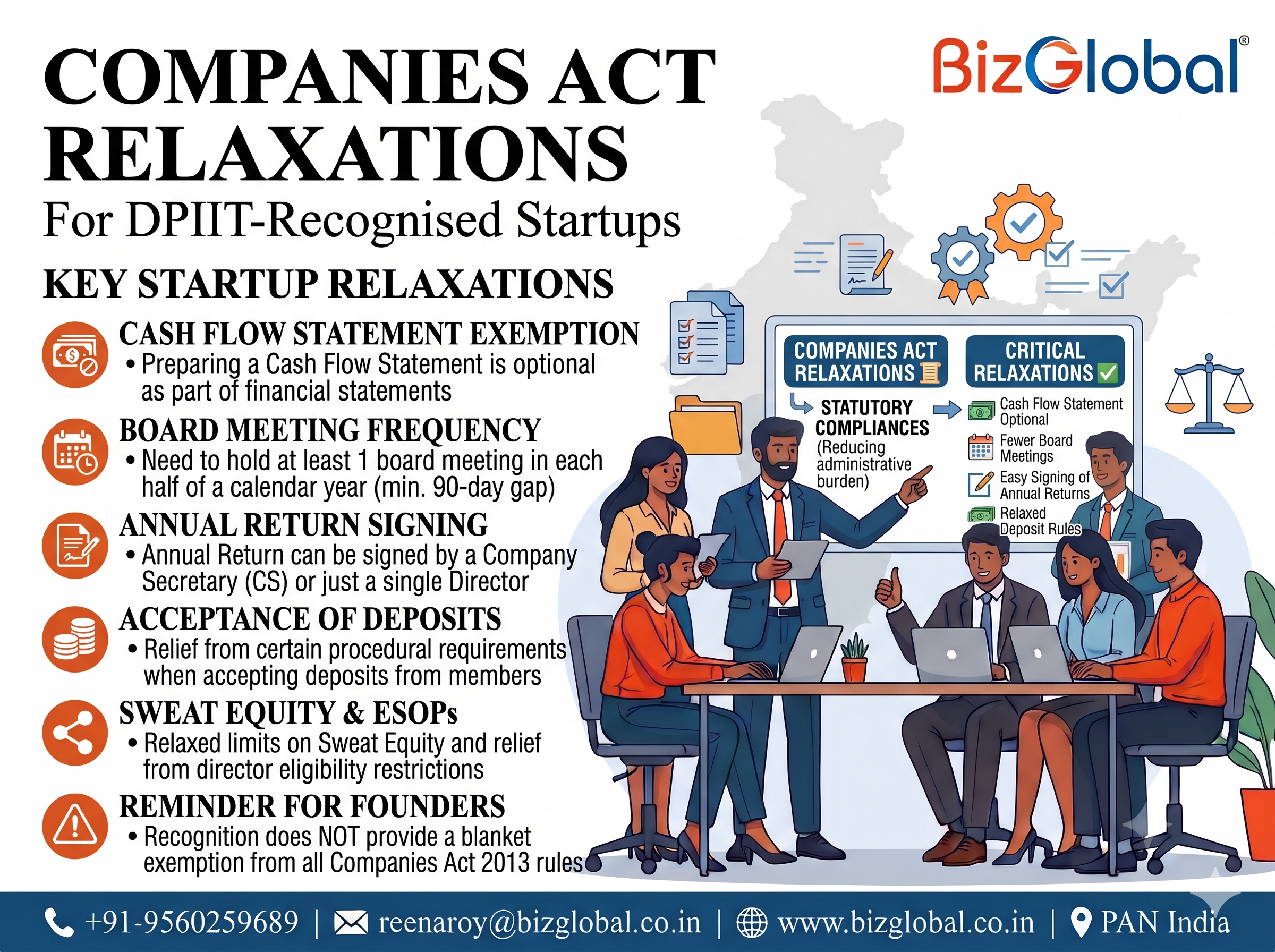
Running a startup involves managing business growth alongside statutory compliance. For eligible startups operating as private limited companies, certain relaxations under the Companies Act, 2013 can reduce administrative requirements and make compliance more manageable.
The availability of each relaxation depends on the applicable provision, the company's status and the conditions prescribed under the relevant rules.
Understanding Companies Act benefits for startups helps directors, Company Secretaries and compliance teams identify the relaxations available while ensuring that essential filings and governance requirements are not overlooked.
What Are Companies Act Relaxations for Startups?
The Ministry of Corporate Affairs has introduced specific measures to reduce compliance burdens for eligible startups.
Before relying on a relaxation, a company should verify its eligibility and the current legal requirements.
1. Relaxation from Preparing a Cash Flow Statement
Under Section 2(40) of the Companies Act, 2013, financial statements generally include a cash flow statement, subject to specified exceptions.
An eligible startup private company may benefit from the exemption that makes the cash flow statement optional as part of its financial statements.
Although an eligible company may not be required to include this statement under the applicable relaxation, it should continue maintaining appropriate accounting records and preparing the other financial statements required by law.
The relaxation should not be interpreted as permission to stop maintaining financial records or disregard other financial statement requirements.
2. Relaxation in Board Meeting Frequency
Section 173 of the Companies Act, 2013 generally prescribes the frequency of board meetings. Eligible startup private companies can benefit from a relaxation that permits a different meeting schedule.
Under the applicable startup-specific provision, the company may hold at least one board meeting in each half of a calendar year, provided the gap between the two meetings is not less than 90 days.
This differs from the general requirement applicable to many companies, which ordinarily involves at least four board meetings each year, subject to statutory exceptions.
The reduced frequency does not remove the board's responsibility to consider important business decisions properly or comply with other applicable provisions.
3. Who Can Sign the Annual Return?
Section 92 of the Companies Act, 2013 governs annual returns. For eligible startup private companies, a relaxation allows the annual return to be signed by the Company Secretary or, where the company does not have a Company Secretary, by a director.
This can be particularly relevant for early-stage companies that do not have a Company Secretary in employment.
It does not mean that the company can ignore the annual return filing requirement or that every startup is exempt from professional certification where separately required.
4. Relaxations Relating to Acceptance of Deposits
Certain startup private companies have received relief from specified procedural requirements when accepting deposits from their members, subject to the relevant conditions.
Before accepting money from members or other parties, review the applicable provisions and obtain appropriate professional advice. Incorrectly treating a receipt as exempt can create significant compliance issues.
5. Relaxations Relating to Sweat Equity and Employee Stock Options
Eligible startups have been permitted to issue sweat equity shares subject to the applicable startup-specific limits and conditions. Rules relating to employee stock options have also provided eligible startups with relief concerning certain promoter and director eligibility restrictions for a prescribed period.
These provisions can help startups structure incentives for employees and eligible contributors. However, the company must comply with the relevant conditions relating to approvals, disclosures, valuation, limits and documentation.
Does DPIIT Recognition Remove All Company Law Compliance?
No. Recognition does not provide a blanket exemption from the Companies Act, 2013.
Eligible startups must continue to assess their obligations relating to financial statements, statutory registers, annual filings, board and shareholder approvals, audit requirements and other applicable provisions.
Review Your Company's Applicable Requirements
Companies Act relaxations can help eligible startups reduce certain procedural burdens, but they must be applied carefully. The correct approach is to identify the specific relaxation, verify the company's eligibility and continue meeting all remaining statutory obligations.
BizGlobal can be approached to discuss your company's compliance requirements and the relaxations potentially applicable to your circumstances, subject to confirmation of the services offered.
Disclaimer: This article provides general information and is not a substitute for reviewing the law applicable to a specific company. Verify current provisions, notifications and eligibility conditions before relying on any relaxation.