
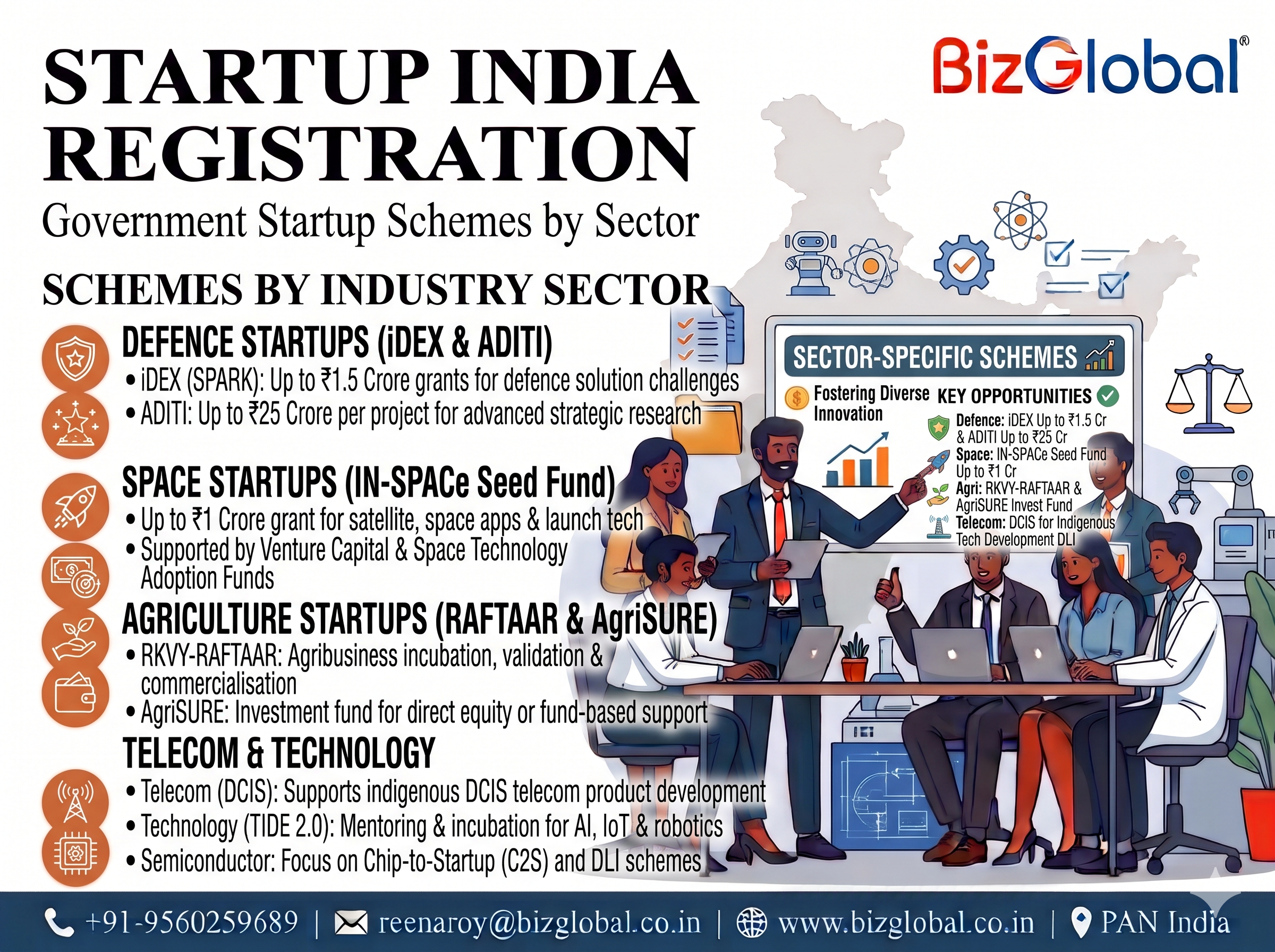
Not every startup has the same funding requirements. A defence technology company may need support to develop and test a prototype, while an agriculture startup may require funding to commercialise a farming solution. Similarly, a space-tech venture may need specialised technical infrastructure, and a telecom startup may need assistance with product development and testing.
The Government of India offers several sector-specific startup schemes to support innovation, research, product development and commercialisation. However, eligibility, funding structures and application routes differ across programmes.
Here is a practical overview of opportunities across five sectors.
1. Defence Startups: iDEX and ADITI
Defence startups developing indigenous technologies can explore the Innovations for Defence Excellence (iDEX) initiative under the Ministry of Defence.
iDEX (Innovations for Defence Excellence) connects startups, MSMEs and individual innovators with defence-related problem statements through initiatives such as the Defence India Startup Challenge (DISC) and Open Challenges.
Selected applicants may receive grants, technical guidance, access to testing facilities and opportunities to engage with defence users. Under the SPARK framework, support can be up to ₹1.5 crore, subject to the relevant challenge guidelines.
ADITI (Acing Development of Innovative Technologies with iDEX) focuses on critical and strategic defence technologies requiring advanced research and development. Its grant support can extend up to ₹25 crore per project, subject to eligibility and selection.
These programmes are relevant to innovators developing solutions aligned with identified defence requirements. They are not general-purpose funding schemes for every technology business.
2. Space Startups: IN-SPACe Seed Fund
India's growing private space ecosystem offers opportunities for startups developing satellite technologies, launch-related solutions, space applications and other space-sector products.
The IN-SPACe Seed Fund Scheme supports eligible Indian space startups and non-government entities developing innovative space products and services.
The scheme has provided grant assistance of up to ₹1 crore per selected startup, subject to programme conditions. Funding may support research, development and prototype creation.
Founders should also examine the broader space-sector support ecosystem, including the Antariksh Venture Capital Fund and Space Technology Adoption Fund. These have different funding structures and should not be confused with the Seed Fund.
3. Agriculture Startups: RKVY-RAFTAAR and AgriSURE
Agritech startups working in areas such as precision farming, food processing, farm mechanisation, supply-chain management and agricultural innovation may explore agriculture-focused programmes.
RKVY-RAFTAAR supports agricultural innovation and entrepreneurship through selected agribusiness incubators. Depending on the applicable programme guidelines and selection, startups may receive support for idea development, validation and commercialisation.
AgriSURE (Agri Fund for Startups and Rural Enterprises) is an investment fund supporting startups and enterprises in agriculture and allied sectors. It operates through investment structures, including eligible funds and direct equity investments. It is therefore not simply a grant that every applicant can claim.
Founders should assess whether their business falls within the fund's investment focus and review the applicable application or investment route.
4. Telecom Startups: Digital Communication Innovation Square
Telecom and communication technology startups may explore the Digital Communication Innovation Square (DCIS) initiative of the Department of Telecommunications.
The programme is intended to encourage indigenous innovation in telecom products, solutions and technologies. Support may cover research, product development, prototyping and commercialisation, depending on the relevant call and guidelines.
Startups should check the current challenge areas, eligible applicant categories, funding limits and application deadlines before preparing a proposal.
5. Technology Startups: TIDE 2.0 and Other Opportunities
Technology startups developing solutions using artificial intelligence, Internet of Things, robotics, blockchain and other emerging technologies may explore the Technology Incubation and Development of Entrepreneurs (TIDE 2.0) scheme.
Implemented through selected incubators, TIDE 2.0 supports technology entrepreneurship through incubation, mentoring, technical assistance and funding-related support. The nature and amount of assistance depend on the participating centre and applicable programme conditions.
Semiconductor startups may also examine the Design Linked Incentive (DLI) Scheme and Chips to Startup (C2S) programme, depending on whether they are developing chip designs, semiconductor technologies or related capabilities.
How to Choose the Right Scheme?
Before applying, founders should compare programmes on these parameters:
- Sector eligibility: Does the programme specifically cover your industry or technology?
- Development stage: Is it intended for research, prototype development, pilot testing or commercialisation?
- Nature of support: Is the assistance a grant, equity investment, incubation facility or another form of financial support?
- Application route: Do you apply directly, through an incubator or through a designated fund?
- Funding conditions: Check milestones, permitted expenditure, reporting obligations and repayment or equity requirements.
- Current availability: Confirm whether applications are open and whether the latest guidelines have changed.
How BizGlobal Can Help?
Identifying a suitable scheme is only one part of the process. Startups may also need support with incorporation-related records, statutory compliance, documentation and maintaining accurate corporate information.
BizGlobal may assist with relevant incorporation, registration and compliance requirements, subject to confirmation of service availability and scope. Scheme eligibility, technical evaluation and funding approval remain with the respective authorities, incubators or fund managers.