
Raising capital is one of the biggest challenges for startups, particularly when they move from early operations to expansion. While some founders prefer equity investment to support long-term growth, others may want debt financing without immediately diluting ownership.
The Government of India supports startup financing through different initiatives, including the Fund of Funds for Startups (FFS) and the Credit Guarantee Scheme for Startups (CGSS). Although both aim to improve access to capital, their funding structures, application routes and financial implications are different.
Understanding FFS vs CGSS for startups can help founders and finance professionals identify which funding route better suits their business requirements.
1. What Is the Fund of Funds for Startups?
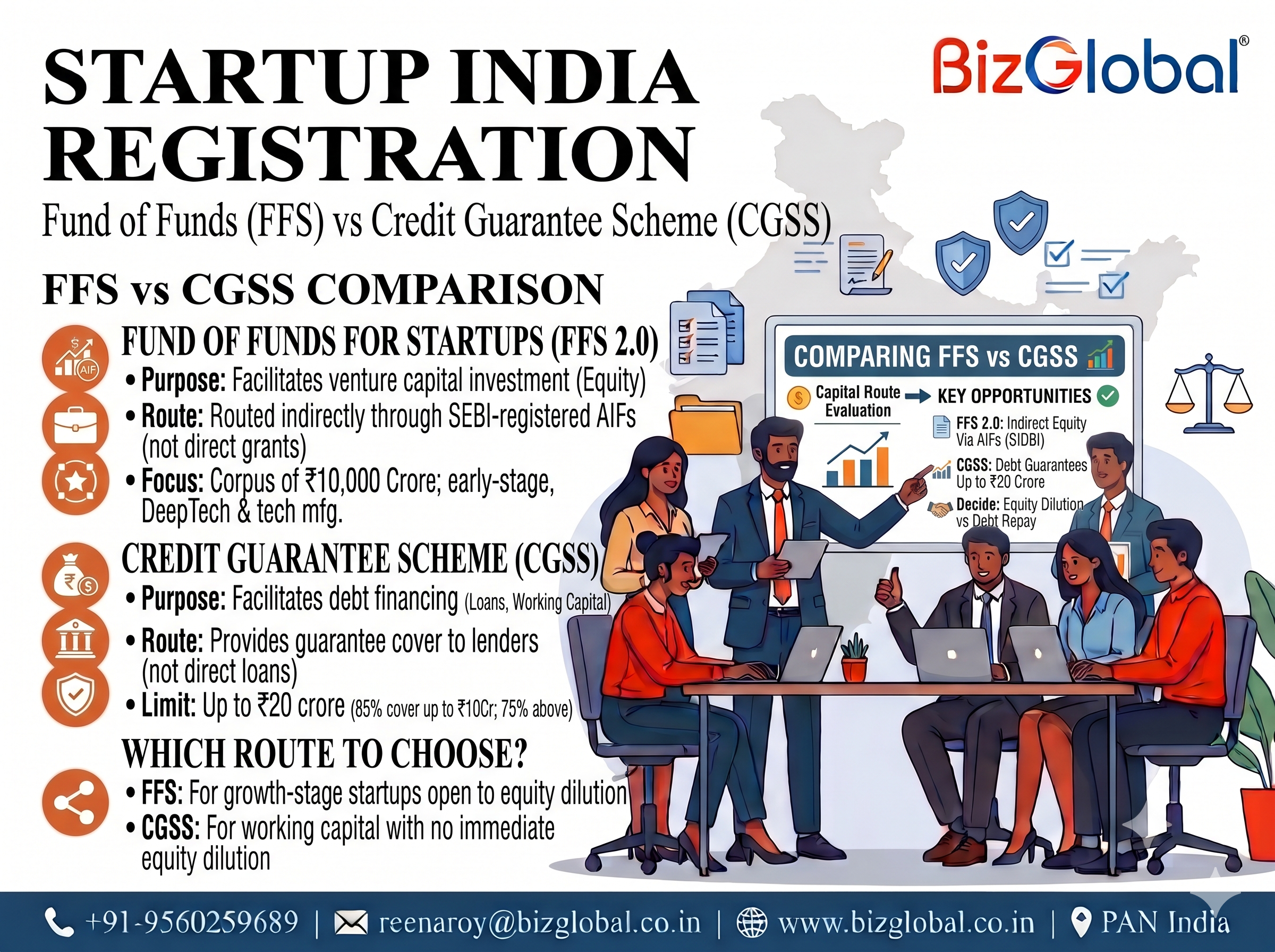
The Fund of Funds for Startups was established to encourage venture capital investment in eligible startups. It is operated through the Small Industries Development Bank of India (SIDBI), which commits capital to eligible SEBI-registered Alternative Investment Funds (AIFs). These AIFs then invest in startups.
The important point is that FFS does not directly invest in startups. Founders generally approach suitable AIFs whose investment strategies match their business sector and growth stage.
In April 2026, the Government notified Startup India Fund of Funds 2.0, with a corpus of ₹10,000 crore. It aims to mobilise venture and growth capital through eligible AIFs, with focus areas including deep technology, early-growth startups and technology-driven innovative manufacturing.
2. What Is the Credit Guarantee Scheme for Startups?
The Credit Guarantee Scheme for Startups facilitates debt financing for eligible DPIIT-recognised startups. It provides guarantee cover to eligible lending institutions against specified credit facilities extended to startups.
The scheme is operated through the National Credit Guarantee Trustee Company (NCGTC). Eligible startups can approach participating banks, financial institutions, NBFCs or eligible AIFs for funding.
Under the revised framework, the maximum debt eligible for guarantee cover is ₹20 crore per borrower. The guarantee coverage is generally:
- 85% of the amount in default for eligible loans up to ₹10 crore.
- 75% of the amount in default for eligible loans exceeding ₹10 crore.
The scheme supports eligible debt facilities such as venture debt, working capital and term loans, subject to its guidelines. Importantly, the guarantee protects the lending institution against a specified portion of the loss; it does not cancel the startup’s repayment obligation.
Which Funding Option Should a Startup Choose?
The right option depends on the startup’s financial position and objectives.
Consider FFS-backed investment if:
- The business is seeking equity capital for growth.
- Founders are comfortable with ownership dilution.
- The startup has a scalable business model and an investment proposition suited to venture capital.
- The company wants access to an AIF’s investor network, expertise and mentorship.
Consider CGSS-supported debt if:
- The business requires working capital or term financing.
- Founders want to avoid immediate equity dilution.
- The startup can demonstrate repayment capacity.
- The company satisfies the applicable DPIIT recognition and lender eligibility requirements.
Neither route guarantees funding. AIFs make investment decisions based on their mandates and due diligence, while lending institutions assess creditworthiness, viability and repayment capacity.
Get Professional Guidance Before Choosing a Funding Route
Choosing between equity and debt requires a clear understanding of the startup's financial position, ownership structure and future plans. Founders should review the applicable scheme guidelines and obtain appropriate financial and legal advice before entering into an investment or borrowing arrangement.
BizGlobal may be considered for relevant startup compliance and documentation support, subject to confirmation of service availability and the specific requirements involved. Funding approval remains the responsibility of the relevant AIF, lender or authorised institution.
Disclaimer: This article is for general informational purposes only and does not constitute financial, legal or investment advice. Scheme conditions, eligibility and operational guidelines may change. Verify the latest official requirements before applying.