
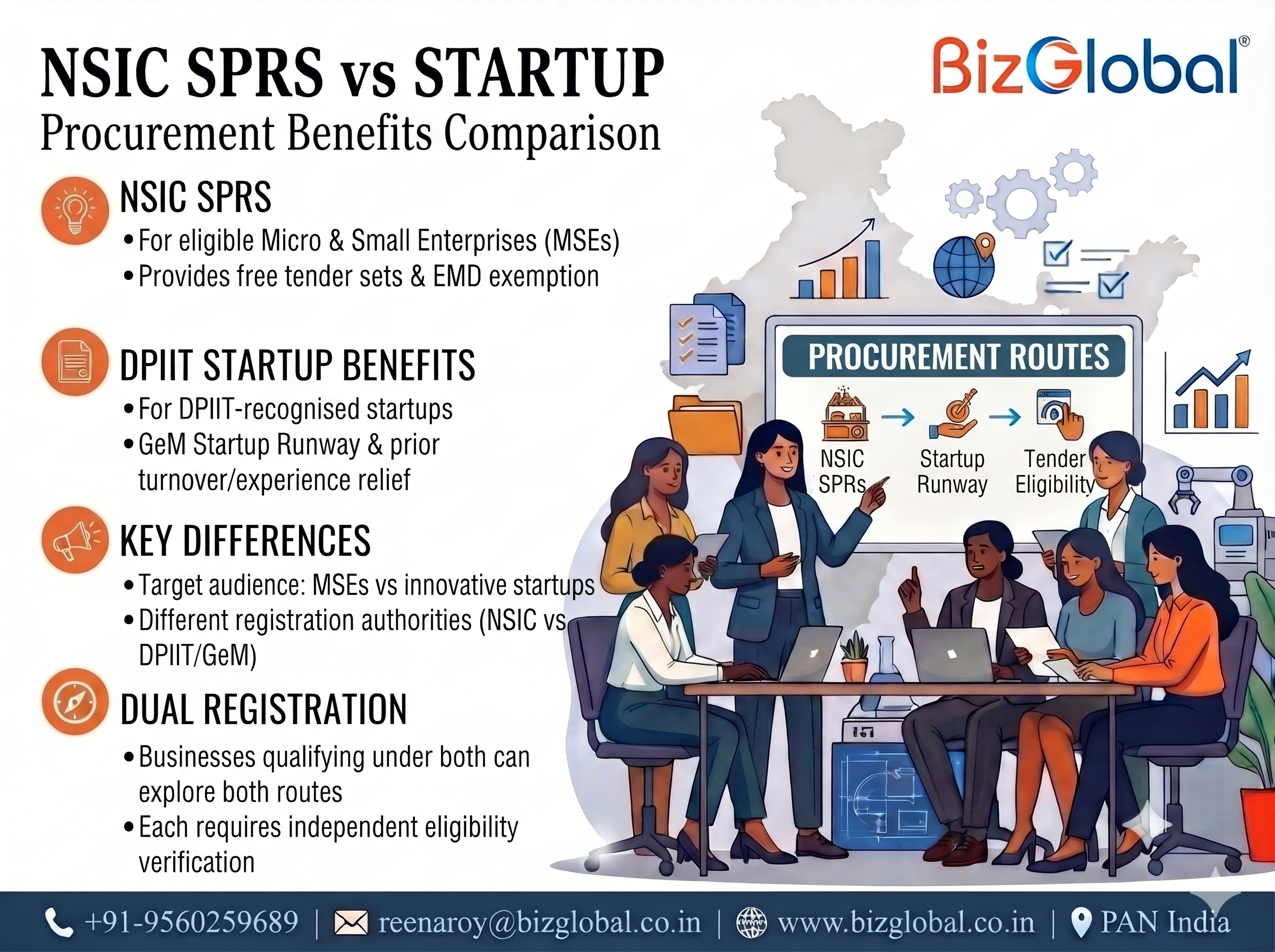
Government procurement can create valuable business opportunities for startups and Micro and Small Enterprises (MSEs). However, accessing these opportunities may require businesses to meet eligibility conditions relating to turnover, prior experience, EMD and registration.
Two important routes are the NSIC Single Point Registration Scheme (SPRS) and procurement benefits available to DPIIT-recognised startups under the Startup India initiative.
Although both aim to improve access to government buyers, their eligibility conditions and benefits are different.
What Is the NSIC Single Point Registration Scheme?
The Single Point Registration Scheme is operated by the National Small Industries Corporation (NSIC), under the Ministry of Micro, Small and Medium Enterprises.
It enables eligible Micro and Small Enterprises to participate in government purchases and access benefits under the Public Procurement Policy for MSEs.
SPRS eligibility
Businesses generally need to:
- Qualify as a Micro or Small Enterprise under the applicable MSME classification.
- Hold a valid Udyam Registration.
- Be engaged in eligible manufacturing or service activities.
- Meet NSIC's documentation and inspection requirements.
Wholesale traders, retail traders and commission agents are among the categories excluded under the scheme.
Newly established MSEs that have commenced commercial production but have not completed one year may apply for provisional registration, subject to the scheme conditions. The provisional certificate carries a monetary limit of ₹5 lakh.
A regular SPRS certificate is valid for two years and requires renewal.
Benefits of NSIC Registration for Government Tenders
Eligible MSEs holding valid SPRS registration can access the following benefits:
- Free tender documents: Eligible registered MSEs can obtain tender sets without payment.
- EMD exemption: Registered MSEs receive exemption from payment of Earnest Money Deposit, subject to applicable procurement conditions.
- Purchase preference: Eligible MSEs quoting within the L1+15% price band may receive an opportunity to supply a portion of the requirement by matching the L1 price, under the applicable policy.
- Consortia facility: NSIC provides a tender marketing consortia facility for eligible enterprises.
The Central Government's Public Procurement Policy also provides for a minimum annual procurement target of 25% from MSEs, with sub-targets of 4% for SC/ST-owned MSEs and 3% for women-owned MSEs.
These are overall procurement targets, not a guarantee that an individual registered enterprise will receive an order.
What Are Startup Procurement Benefits?
DPIIT-recognised startups can access separate procurement-related benefits under the Startup India initiative.
One important opportunity is GeM Startup Runway, which allows startups to showcase innovative products and services to government buyers through the Government e-Marketplace.
Startup-related procurement benefits include:
- Opportunity to list innovative products and services on GeM.
- Startup identification through the Startup India badge.
- EMD exemption under the applicable procurement framework.
- Relaxation from prior experience and turnover conditions in eligible procurements.
The Startup India scheme describes prior experience and turnover relaxation for manufacturing-sector startups, subject to quality standards, technical requirements and the startup's ability to execute the contract. It also specifies the requirement for an Indian manufacturing facility.
Founders should verify the applicable notification and tender conditions before claiming these relaxations.
NSIC SPRS vs Startup Procurement Benefits
|
Comparison |
NSIC SPRS |
DPIIT Startup Benefits |
|
Main eligibility |
Micro and Small Enterprises |
|
|
Registration authority |
NSIC |
DPIIT recognition; GeM seller registration for marketplace participation |
|
Primary objective |
Government purchase participation by MSEs |
Market access for innovative startups |
|
EMD exemption |
Available to eligible registered MSEs |
Available under applicable startup procurement provisions |
|
Prior turnover relaxation |
Depends on tender and applicable MSE rules |
Available under specified startup procurement conditions |
|
Prior experience relaxation |
Depends on tender and applicable MSE rules |
Available under specified startup procurement conditions |
|
Main platform |
NSIC SPRS and relevant procurement portals |
GeM Startup Runway and relevant tender portals |
Can a Business Use Both Routes?
Potentially, yes.
A business that qualifies as both a DPIIT-recognised startup and an eligible Micro or Small Enterprise may explore both routes.
For example, a young manufacturing startup with valid Udyam registration may assess its eligibility for NSIC SPRS while also using its DPIIT recognition to access GeM Startup Runway.
However, registration under one scheme does not automatically grant benefits under the other. The business must independently satisfy the eligibility conditions and follow the applicable registration process.
Founders should also check whether their SPRS certificate and relevant benefits are recognised for the particular procurement platform or tender.
Which Route Should You Choose?
Consider NSIC SPRS if your business qualifies as a Micro or Small Enterprise and regularly supplies goods or services to government buyers.
Consider DPIIT startup procurement benefits if your business is recognised by DPIIT and wants to showcase innovative products or explore startup-specific procurement relaxations.
If eligible under both, evaluate the opportunities and conditions of each route before bidding.
Disclaimer: This article is for general informational purposes only. Eligibility, procurement benefits and registration conditions are subject to current government notifications, NSIC guidelines, GeM rules and individual tender documents.