
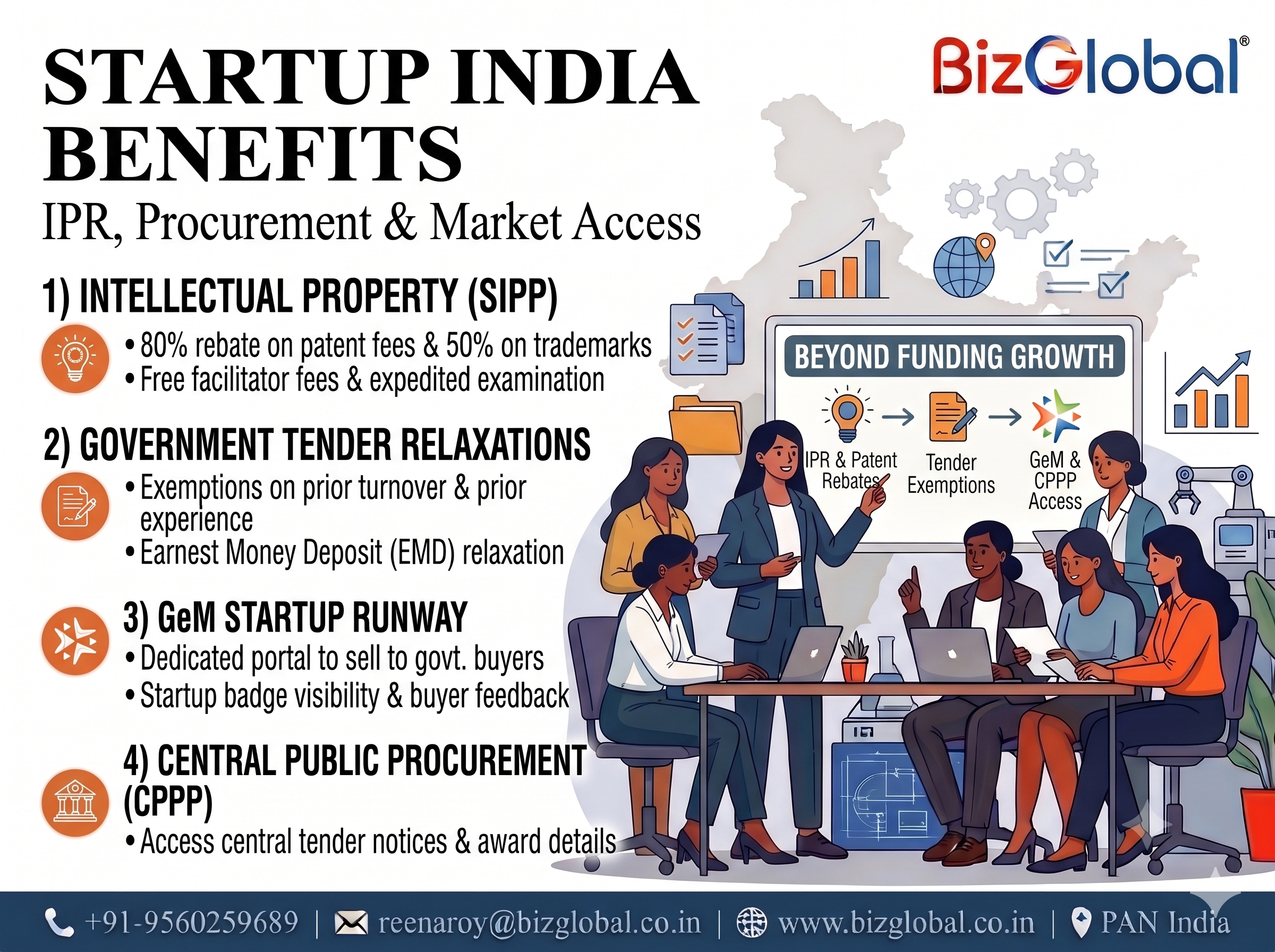
For a startup, receiving funding is only one part of building a sustainable business. Protecting innovations, reaching customers, securing government contracts and establishing market credibility are equally important for long-term growth.
The Startup India initiative offers several benefits beyond financial assistance to eligible DPIIT-recognised startups. These include intellectual property facilitation, patent fee rebates, public procurement relaxations and opportunities to sell products and services to government buyers.
Understanding these Startup India benefits beyond funding can help recognised startups identify opportunities that support their business expansion.
1. Intellectual Property Support for Startups
Intellectual property (IP) can be a valuable business asset, particularly for startups developing innovative products, technologies, software or designs.
Under the Startup India initiative, eligible DPIIT-recognised startups can access support through the Startups Intellectual Property Protection (SIPP) Scheme.
Key benefits include:
- Patent fee rebate: Eligible startups receive an 80% rebate on patent filing fees compared with the fees applicable to other companies.
- Trademark fee rebate: Eligible startups receive a 50% rebate on trademark application fees.
- IPR facilitators: Startups can access a panel of facilitators who assist with patent, trademark and design applications.
- Facilitation cost: The Central Government bears the professional fees of empanelled facilitators for eligible services under the scheme.
- Expedited patent examination: Eligible startups can request expedited examination of patent applications, subject to applicable patent rules.
These benefits can reduce the cost and administrative burden of protecting innovations.
However, founders should remember that patentability, trademark registration and design protection are subject to the applicable intellectual property laws and examination process.
2. Government Tender Benefits for DPIIT-Recognised Startups
Government departments and public sector organisations procure a wide range of goods and services. This creates a potential market for startups offering innovative solutions.
Under applicable public procurement provisions, DPIIT-recognised startups may receive relaxations relating to:
- Prior turnover requirements.
- Prior experience requirements.
- Earnest Money Deposit (EMD) or bid security.
These relaxations are intended to help eligible startups compete despite having a shorter business track record.
However, exemptions are not unconditional. Startups must still satisfy the tender's technical specifications, quality standards and other applicable eligibility requirements. Procuring authorities may retain experience or turnover conditions where justified, including certain sensitive procurements.
Founders should therefore examine each tender carefully instead of assuming that DPIIT recognition removes every qualification requirement.
3. GeM Startup Runway: Access to Government Buyers
The Government e-Marketplace (GeM) is an online procurement platform through which government departments and organisations purchase goods and services.
GeM Startup Runway provides a dedicated opportunity for startups to showcase innovative products and services to government buyers.
Its potential advantages include:
- Listing innovative products and services.
- Reaching government departments and public-sector buyers.
- Greater visibility through a startup identification badge.
- Receiving buyer feedback on listed products and services.
- Exploring government procurement opportunities without relying solely on traditional sales channels.
DPIIT-recognised startups can register as sellers using the prescribed details and complete the applicable seller onboarding process.
However, listing a product on GeM does not guarantee an order. Startups must meet product, seller, quality, pricing and procurement requirements applicable to each opportunity.
4. Access to the Central Public Procurement Portal
Startups can also monitor government tender opportunities through the Central Public Procurement Portal (CPPP).
The portal provides access to tender notices, corrigenda, procurement enquiries and contract award information published by participating central government organisations.
For startups, this can help identify potential buyers, understand procurement requirements and prepare for relevant bidding opportunities.
Before participating, founders should review the tender documents, submission deadlines, technical conditions and applicable exemptions.
How Should Startups Use These Benefits?
The right benefit depends on the startup's business model and growth plans.
|
Business requirement |
Relevant opportunity |
|
Protect an invention |
SIPP and patent facilitation |
|
Protect a brand |
Trademark fee rebate |
|
Sell to government buyers |
GeM Startup Runway |
|
Participate in government tenders |
Applicable public procurement relaxations |
|
Discover central government tenders |
CPPP |
Founders should maintain valid DPIIT recognition details, incorporation records, intellectual property documentation and accurate business information.
How BizGlobal Can Help?
Accessing startup benefits often requires proper business documentation and compliance records. BizGlobal may assist with relevant incorporation, registration and corporate compliance requirements, subject to confirmation of service availability and scope.
IP applications should be handled with appropriately qualified IP professionals, while tender participation and procurement decisions remain subject to the respective portal and tender conditions.
Disclaimer: This article is for general informational purposes only. Benefits, eligibility and scheme conditions are subject to applicable laws, notifications and current official guidelines. Verify the latest requirements before applying or participating in procurement.