
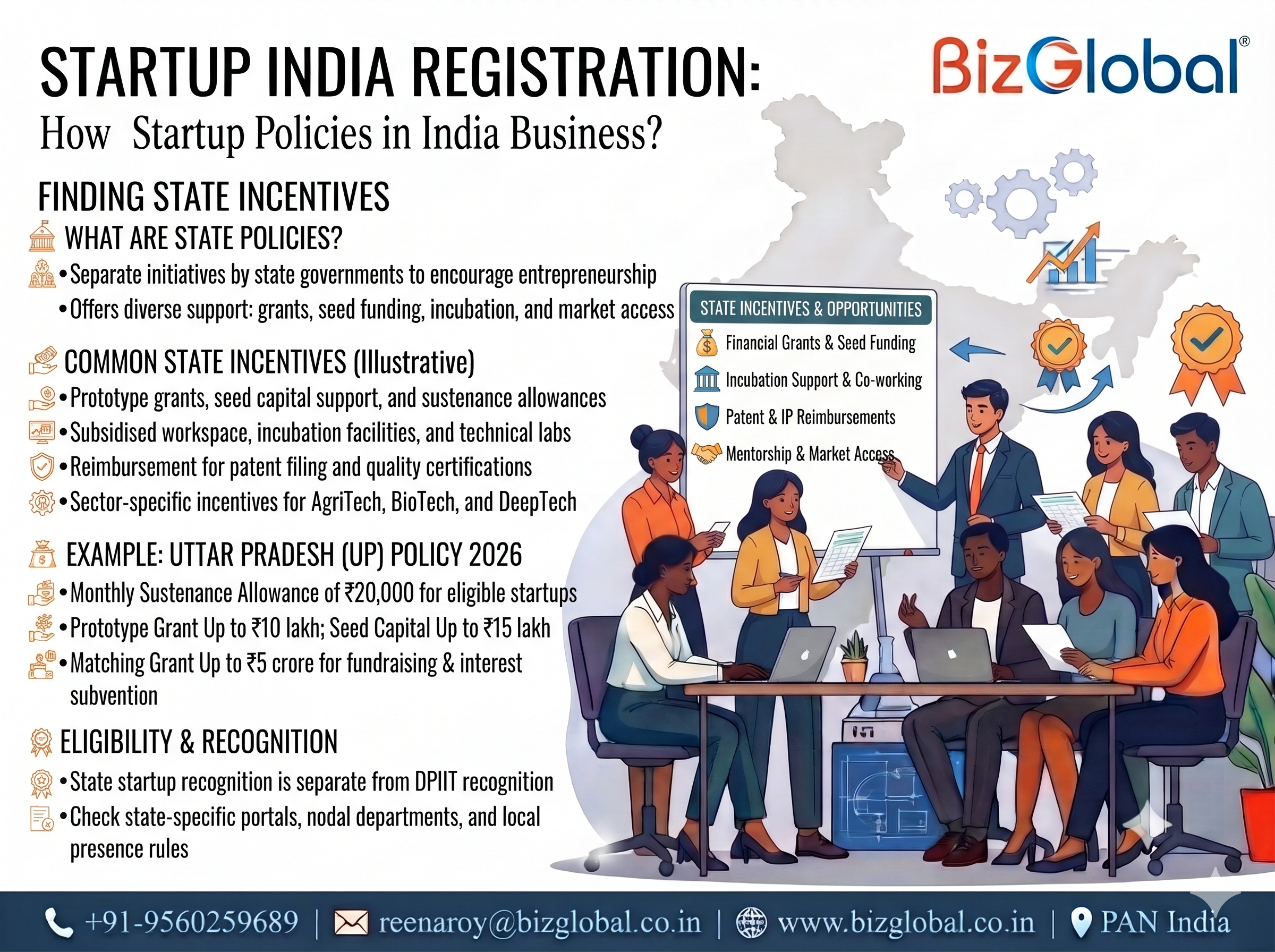
Did you know that your startup may be eligible for financial and non-financial support from the state government where it operates?
Apart from central government initiatives under Startup India, several Indian states and Union Territories have introduced their own startup policies. These policies may offer prototype grants, seed funding, incubation support, patent reimbursements, interest subsidies, mentorship and market access.
However, state startup policies in India are not uniform. An incentive available in one state may not exist in another, and eligibility may depend on where your business is registered, where it operates and the sector in which it works.
Here is how founders can identify the right state-level opportunities.
What Are State Startup Policies?
State startup policies are government initiatives designed to encourage entrepreneurship, innovation, investment and employment within a particular state.
They generally operate through a designated nodal department, startup mission, industry department or implementing agency.
The Startup India portal maintains a directory of state and Union Territory startup policies. Its July 2026 information lists policies or initiatives across 32 States and Union Territories. However, the policy name or presence in a directory does not necessarily mean that applications are currently open.
For founders, the first step is to identify the official policy and its implementing authority.
What Incentives Can State Governments Offer?
Depending on the policy, state government startup incentives may include:
- Financial assistance: Prototype grants, seed support, sustenance allowances and assistance for product development.
- Incubation support: Access to incubators, laboratories, mentoring, infrastructure and industry networks.
- Intellectual property support: Reimbursement or assistance towards eligible patent and trademark expenses.
- Employment-related incentives: Reimbursement of specified employer contributions or support for hiring, where provided.
- Infrastructure assistance: Subsidised workspace, incubation facilities and access to testing infrastructure.
- Market access: Government procurement opportunities, exhibitions, buyer connections and startup events.
- Sector-specific support: Additional incentives for areas such as agriculture, biotechnology, electronics, manufacturing, clean energy and deep technology.
Not every state offers all these benefits. Some incentives are reimbursements after expenditure, while others are grants released against milestones. Founders should understand the payment mechanism before including an incentive in their financial projections.
Example: Uttar Pradesh Startup Policy 2026
The Uttar Pradesh Startup Policy 2026 illustrates how a state policy can combine financial assistance with ecosystem development.
The official UP Startup Mission portal describes several forms of support, including:
- Monthly sustenance allowance of ₹20,000 for eligible startups.
- Prototype grant of up to ₹10 lakh.
- Seed capital support of up to ₹15 lakh.
- Matching grant of up to ₹5 crore for qualifying fundraising.
- Support for quality certification and patent filing.
- Interest subvention on eligible term loans.
- Enhanced assistance for certain DeepTech startups.
The policy also provides for incubation infrastructure, including a proposed DeepTech hub and domain-focused Centres of Excellence.
These figures are policy highlights, not automatic entitlements. Startups must satisfy the relevant conditions, evaluation process and application requirements.
Does DPIIT Recognition Automatically Make You Eligible?
No. DPIIT recognition and state startup recognition are separate matters.
Some state policies adopt the Central Government's startup definition, while others prescribe additional conditions or require registration through their state portal.
A startup may therefore need to obtain DPIIT recognition and separately complete state-level registration or evaluation.
Similarly, receiving an incentive under one government scheme does not automatically establish eligibility for another. Check restrictions on duplicate assistance and overlapping benefits.
What Should Founders Compare Before Choosing a State?
Do not select a business location only because a policy advertises a large grant.
Compare the complete business environment:
- Eligibility and minimum local presence requirements.
- Availability and reliability of incentives.
- Application timelines and reimbursement conditions.
- Incubators, talent and industry connections.
- Infrastructure, logistics and operating costs.
- Sector-specific ecosystem and customer access.
- Compliance and reporting obligations.
A smaller incentive in a state with better infrastructure and market access may be more valuable than a larger grant with restrictive conditions.
Disclaimer: This article is for general informational purposes only. Incentive amounts, eligibility, application windows and scheme conditions may change. Refer to the latest official notifications and implementing agency guidelines before applying.