
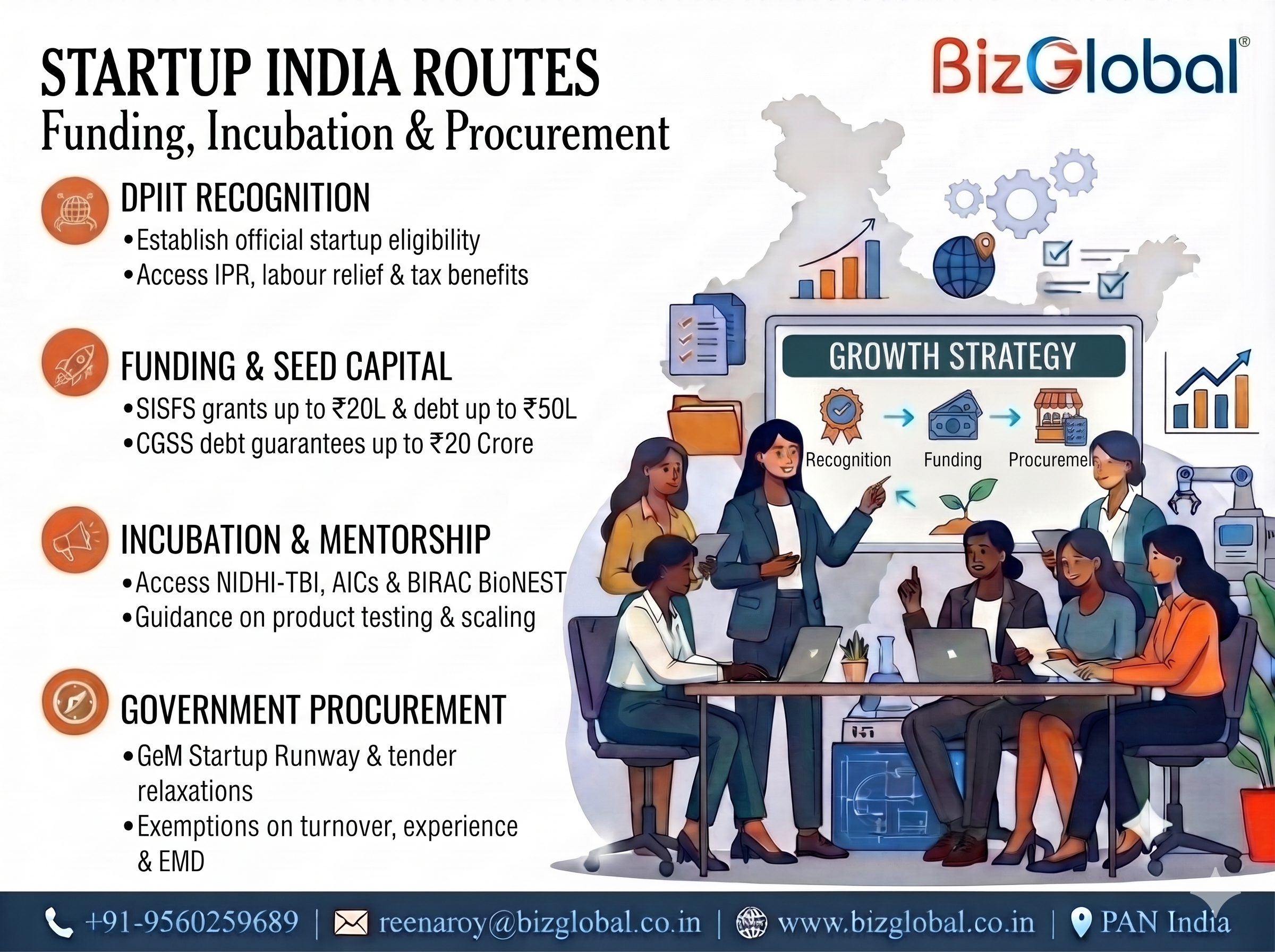
Getting your startup recognised under the Startup India initiative is an important milestone. But what should you do next? Should you apply for funding, approach an incubator, explore government tenders or first obtain DPIIT recognition?
These opportunities serve different purposes. DPIIT recognition establishes your startup's eligibility to apply for certain benefits, while funding, incubation and government procurement address different business needs.
Understanding the distinction can help founders choose the right growth opportunity instead of applying for schemes without a clear objective.
DPIIT Recognition: Establish Your Startup's Eligibility
DPIIT recognition is an official recognition under the Startup India initiative for eligible entities working towards innovation, improvement or scalable business models.
Under the revised framework, general startups can qualify within 10 years of incorporation and with turnover not exceeding ₹200 crore in any financial year. Eligible DeepTech startups may qualify within 20 years and with turnover not exceeding ₹300 crore, subject to the applicable conditions.
Recognition can provide access to benefits such as:
- Intellectual property support and eligible fee concessions.
- Self-certification under specified labour and environmental laws.
- Relaxations in eligible government procurement processes.
- Access to certain funding and government support schemes.
- Opportunities through Startup India programmes.
However, DPIIT recognition does not automatically provide funding, tax exemption or procurement orders. Each benefit has separate eligibility requirements and application procedures.
Funding Schemes: When Your Startup Needs Capital
If your startup needs money to develop a prototype, test a product, enter the market or scale operations, funding schemes may be relevant.
Some important routes include:
Startup India Seed Fund Scheme (SISFS): Designed to support eligible early-stage startups through approved incubators. Assistance can include grants of up to ₹20 lakh for proof of concept, prototype development and product trials, and investment of up to ₹50 lakh through debt or convertible instruments for market entry and scaling. Separate eligibility and application conditions apply.
Credit Guarantee Scheme for Startups (CGSS): Supports eligible lending to DPIIT-recognised startups through approved financial institutions. It provides credit guarantee cover to lenders, rather than a direct grant to the startup. The startup remains responsible for repayment.
Fund of Funds for Startups 2.0: The ₹10,000 crore initiative is designed to mobilise venture capital through eligible Alternative Investment Funds (AIFs). Startups generally access this capital through participating funds, not by applying directly to the government for a grant.
Choose a funding route according to your stage, capital requirement, repayment capacity and intended use of funds.
Incubation: When Your Startup Needs Guidance and Infrastructure
An incubator can be useful when your startup needs more than money.
Incubation programmes may provide:
- Mentorship from industry experts.
- Business model development.
- Product testing and prototype facilities.
- Access to laboratories and technical infrastructure.
- Investor and industry connections.
- Guidance on intellectual property and commercialisation.
Examples include NIDHI Technology Business Incubators, Atal Incubation Centres, BIRAC BioNEST and MeitY-supported incubation initiatives.
Remember that an incubator is not necessarily a funding agency. Some provide infrastructure and mentorship, while others may facilitate grants or investment through separate programmes.
Government Procurement: When You Are Ready to Sell
If your startup has a product or service that can meet government requirements, public procurement may offer a route to customers.
DPIIT-recognised startups can explore GeM Startup Runway and eligible procurement relaxations relating to prior experience, turnover and Earnest Money Deposit (EMD).
However, these benefits do not remove the need to satisfy technical specifications, quality standards, licences, delivery conditions and tender-specific requirements.
Government procurement is therefore more suitable when your business has a product or service ready for supply and the operational capacity to execute contracts.
Which Route Should You Explore?
|
Your current requirement |
Route to consider |
|
Need official startup recognition |
|
|
Need prototype or early-stage capital |
Seed funding schemes |
|
Need credit or debt support |
CGSS and eligible lenders |
|
Need mentorship and infrastructure |
Startup incubators |
|
Need access to government buyers |
GeM and public procurement |
|
Need venture capital for growth |
AIFs and investor networks |
A startup may explore more than one route, provided it independently satisfies the conditions of each programme.
A Practical Checklist Before Applying
Before choosing a scheme, ask yourself:
- Is my business eligible for DPIIT recognition?
- What is my immediate requirement: capital, mentorship, infrastructure or customers?
- Does the scheme support my startup's stage and sector?
- Are applications currently open?
- What documents, milestones and reporting obligations are involved?
- Does the scheme restrict overlapping government assistance?
Prepare your incorporation documents, business plan, financial projections, product information, founder details and relevant registrations before approaching an implementing agency.
Disclaimer: This article is for general informational purposes only. Scheme availability, eligibility, funding limits and application windows may change. Refer to the latest official guidelines before making an application.