
Are you planning to start a business on your own but do not want to operate as a sole proprietorship? A One Person Company, commonly known as an OPC, may be one of the business structures worth exploring.
Many solo founders want the independence of running a business themselves while also having a formal company structure. This is where an OPC can become relevant. However, before choosing this structure, it is important to understand what an OPC is, who can incorporate one and whether it actually suits your business plans.
What Is a One Person Company?
Under the Companies Act, 2013, a One Person Company is a company that has only one person as its member. The law allows one person to form an OPC as a private company by subscribing to its memorandum and completing the applicable incorporation requirements.
In simple terms, an OPC gives an individual entrepreneur the option to operate through a company structure without needing a second shareholder merely to meet the usual minimum membership requirement for a private company.
An OPC is a separate legal entity from its member. This distinction is one of the key reasons why entrepreneurs may consider an OPC instead of operating through a sole proprietorship.
Key Features of an OPC
Understanding the main features of an OPC can help you decide whether it deserves a place on your shortlist of business structures.
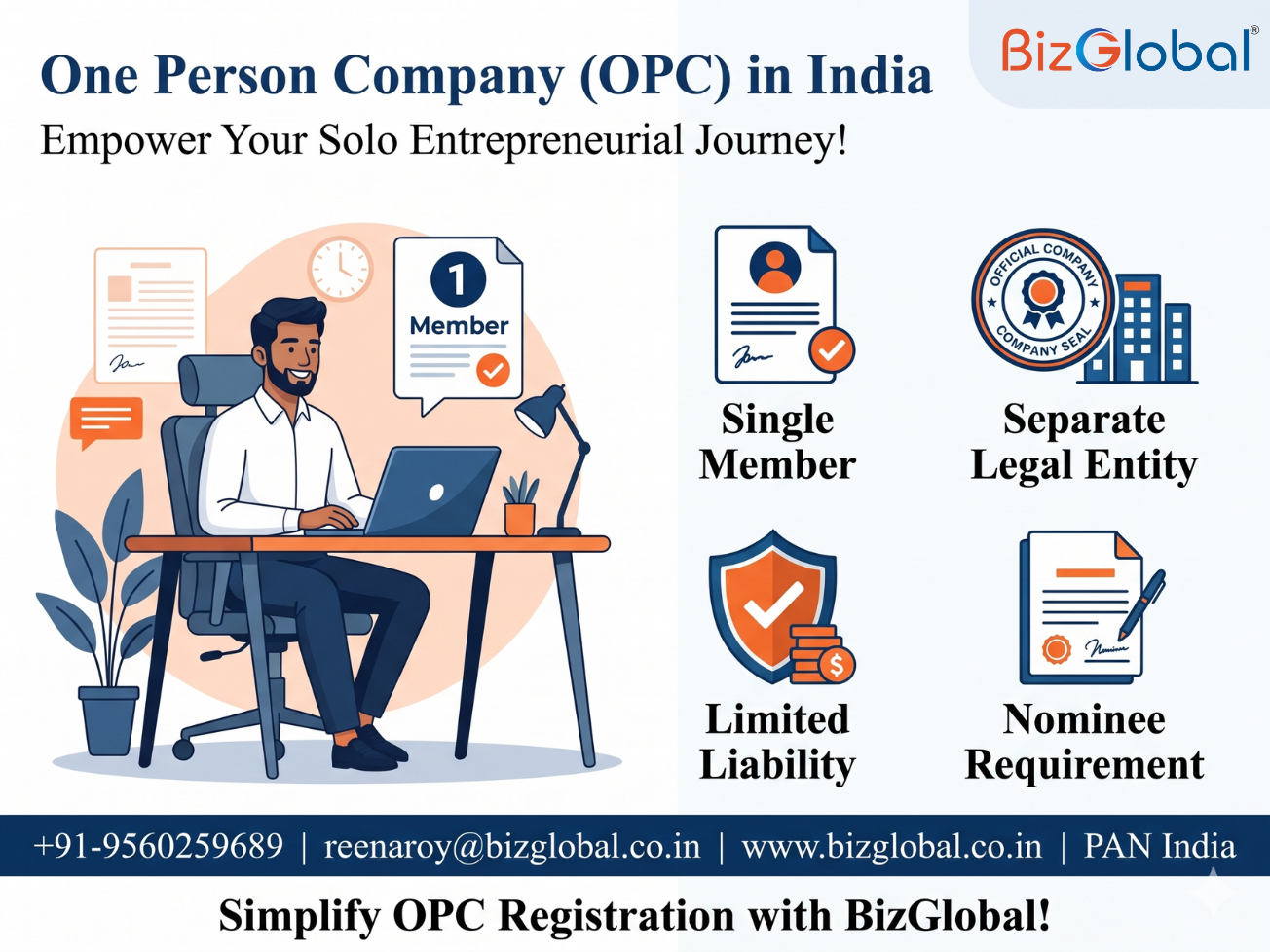
1. Single Member
An OPC has only one member. This makes it particularly relevant for entrepreneurs who want to establish and control a company independently.
2. Separate Legal Entity
Once incorporated, the company has a legal identity separate from its member. The company can own assets and enter into transactions in its own name, subject to the applicable legal framework.
3. Limited Liability
One of the important benefits of a company structure is the principle of limited liability. However, this does not mean that a member or director is protected from every possible legal or financial responsibility.
4. Nominee Requirement
An OPC must have a nominee. The subscriber nominates another eligible person, with that person's prior written consent, who can become the member of the company in the event of the subscriber's death or incapacity to contract.
For a detailed discussion on this requirement, readers can explore our guide on OPC nominees: their role and important requirements.
Who Is Eligible to Incorporate an OPC?
OPC eligibility is governed by the Companies Act and the applicable Companies (Incorporation) Rules.
Following the amendments that took effect in 2021, a natural person who is an Indian citizen may incorporate an OPC, whether resident in India or otherwise. The rules also place conditions on the number of OPCs in which a person may be a member or nominee.
A minor cannot become a member or nominee of an OPC. There are also restrictions on an OPC being incorporated or converted into a company under Section 8, and on carrying out certain non-banking financial investment activities.
Our detailed guide on who can register a One Person Company in India can help you understand these requirements in greater detail.
Is a One Person Company Right for Your Business?
An OPC may be worth considering if you are a solo entrepreneur who:
- Wants to operate through a company structure
- Does not currently require multiple members
- Wants to understand the benefits and responsibilities of a separate legal entity
- Is prepared to meet the applicable incorporation and ongoing compliance requirements
However, an OPC may not automatically be the right answer for every individual business owner.
For example, a freelancer with a relatively simple business model may compare an OPC with a sole proprietorship or LLP. A founder expecting to bring in co-founders or investors may also need to consider whether another structure is more suitable for their future plans.
That is why choosing a business structure should not be based only on popularity or the perception that one structure is always better than another. The nature of the business, ownership plans, growth strategy and compliance responsibilities should all be considered.
You may also find our comparison guides on OPC vs Sole Proprietorship, OPC vs Private Limited Company and OPC vs LLP useful.
How BizGlobal Can Help?
Choosing the right business structure is an important decision, especially for a first-time entrepreneur.
BizGlobal can help entrepreneurs understand the applicable incorporation requirements, organise the necessary information and documentation, and understand the procedural steps involved in establishing a business structure.