
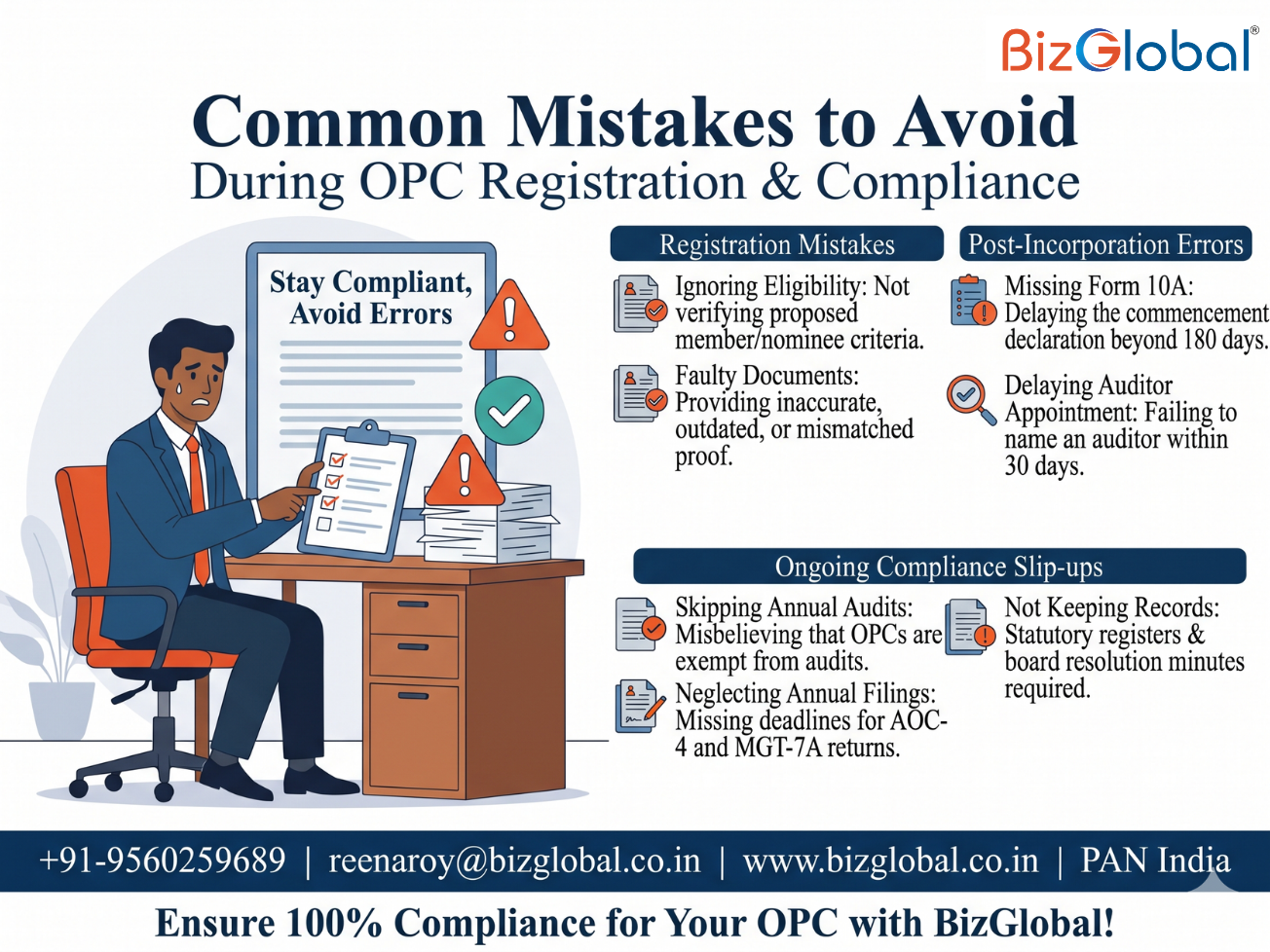
A One Person Company (OPC) is a suitable business structure for an individual entrepreneur who wants to operate through a separate legal entity. It offers the advantage of single-member ownership while providing a formal corporate structure.
However, registering an OPC is not simply a matter of submitting an online application to the Ministry of Corporate Affairs (MCA). Founders must satisfy the eligibility requirements, prepare accurate incorporation documents, appoint a nominee and comply with the applicable provisions of the Companies Act, 2013.
Mistakes during incorporation can result in resubmission, delays or rejection of an application. Errors after incorporation can lead to additional fees, penalties and other regulatory complications.
This article discusses the common OPC registration mistakes and compliance errors that prospective and existing OPC owners should avoid.
1. Not Checking OPC Eligibility Before Starting the Registration
One of the first mistakes is beginning the incorporation process without checking whether the proposed member satisfies the eligibility requirements.
The eligibility position was amended with effect from 1 April 2021. Therefore, relying on older articles that state that only a resident Indian can incorporate an OPC may lead to an incorrect conclusion.
How to avoid this mistake: Check the current eligibility conditions under Rule 3 of the Companies (Incorporation) Rules, 2014 before selecting the proposed member and nominee.
To read the eligibility criteria in detail, read our detailed guide on Who Can Register a One Person Company in India? OPC Eligibility Explained.
2. Selecting a Nominee Without Understanding the Legal Requirement
The nominee requirement is frequently misunderstood.
Some founders assume that the nominee becomes a second shareholder or director immediately after incorporation. This is incorrect.
Under Section 3(1) of the Companies Act, 2013, the nominee is the person who may become the member of the OPC in the event of the sole member's death or incapacity to contract.
How to avoid this mistake: Select an eligible nominee who understands the arrangement, obtain prior written consent and maintain the relevant documentation. Any subsequent change should be reported in accordance with the applicable rules.
For a detailed explanation, read our article on OPC Nominee: Role, Requirements and Important Things to Know.
3. Choosing a Company Name Without Checking Its Availability
A proposed company name may look suitable to the founder but may not satisfy MCA naming requirements.
Name-related issues can arise where:
- The proposed name is identical or too similar to an existing company or registered trademark.
- The name suggests an activity that the company is not authorised to undertake.
- The name contains restricted or regulated words without the necessary approval.
- The proposed name does not comply with the applicable naming guidelines.
A name reservation application may therefore face rejection or require resubmission.
How to avoid this mistake: Conduct an appropriate name search and trademark check before submitting the name reservation application. The proposed name should also reflect the company's intended business activities and comply with the Companies (Incorporation) Rules, 2014.
4. Drafting the Main Objects Clause Without Proper Planning
The objects clause in the Memorandum of Association (MOA) describes the activities for which the company is being incorporated.
A common mistake is copying a generic objects clause from another company's incorporation documents without considering the proposed business. This can create problems when the company begins operations or applies for registrations, licences or approvals.
For example, an entrepreneur intending to provide technology consultancy services should ensure that the objects clause appropriately covers the proposed activities rather than relying on an unrelated generic description.
How to avoid this mistake: Draft the objects clause based on the actual business model, intended activities and applicable regulatory requirements. Avoid including activities merely because they appear in another company's MOA.
5. Submitting Incorrect or Incomplete Incorporation Documents
Documentation errors are among the most common OPC incorporation mistakes.
The MCA incorporation process requires specific information and supporting documents relating to the proposed member, nominee and registered office. Even a small mismatch can result in a resubmission requirement.
How to avoid this mistake: Prepare a document checklist before starting the filing. Cross-check the details in the application, MOA, AOA, nominee consent and supporting documents. Ensure that the documents are legible, valid and consistent.
For a detailed checklist, read Documents Required for One Person Company Registration in India.
6. Providing Incorrect Registered Office Details
The registered office is the official address of the company for receiving communications and notices. Providing an incorrect address or incomplete supporting documents can create incorporation and post-incorporation difficulties.
How to avoid this mistake: Confirm the availability of the premises, obtain the necessary owner consent and supporting documents, and ensure that the registered office information is correctly reported to the Registrar of Companies (ROC).
7. Assuming That the Certificate of Incorporation Completes Every Formality
Receiving the Certificate of Incorporation is an important milestone, but it does not mean that all statutory requirements have been completed. An OPC may have additional post-incorporation responsibilities, depending on its circumstances.
How to avoid this mistake: Prepare a post-incorporation compliance checklist immediately after receiving the Certificate of Incorporation. Track the applicable declarations, auditor appointment, registered office verification and other statutory requirements.
8. Assuming That an OPC Does Not Require an Audit
Another common misconception is that an OPC is exempt from statutory audit because it has only one member.
This is incorrect.
An OPC is required to get its financial statements audited in accordance with the applicable provisions of the Companies Act, 2013.
Section 139(6) provides that the Board of Directors must appoint the first auditor within 30 days from the date of registration. If the Board fails to do so, the member must be informed and the auditor is to be appointed by the member within the prescribed 90-day period.
How to avoid this mistake: Plan the appointment of the statutory auditor soon after incorporation. Maintain proper books of account and coordinate with the auditor for the annual audit and preparation of financial statements.
9. Missing Annual ROC Filings
OPCs have certain procedural relaxations under company law, but they are still required to complete their annual filings.
Two important annual filing requirements are:
AOC-4: Filing of financial statements
Under Section 137 of the Companies Act, 2013, an OPC must file its financial statements, duly adopted by its member, with the Registrar within 180 days from the closure of the financial year.
MGT-7A: Annual return
An OPC is required to file its annual return in Form MGT-7A, the prescribed abridged annual return for OPCs and small companies.
Founders should not assume that the absence of an AGM removes the annual return filing requirement. The applicable filing timeline and form instructions should be checked for the relevant financial year.
How to avoid this mistake: Maintain an annual compliance calendar, prepare the financial statements on time and track the due dates for AOC-4 and MGT-7A separately.
10. Confusing OPC Relaxations With Complete Exemption From Compliance
An OPC receives certain procedural relaxations under the Companies Act, 2013. However, these relaxations do not mean that it is exempt from all corporate compliance requirements.
A common mistake is to assume that because an OPC does not conduct an AGM, it does not need to record decisions or maintain minutes.
How to avoid this mistake: Understand the specific exemptions available to an OPC and distinguish them from the requirements that continue to apply. Record the member's decisions and the relevant director's decisions in the prescribed manner.
11. Ignoring Tax and Other Business Registrations
ROC compliance is only one part of running an OPC.
Depending on the nature, size and location of the business, the company may also have obligations under the Income-tax Act, GST laws, employment-related legislation and other applicable regulatory frameworks.
How to avoid this mistake: Prepare a compliance checklist based on the company's actual operations. Do not assume that ROC filings alone are sufficient to keep the business compliant.
How BizGlobal Can Help?
OPC registration and compliance involve more than completing online forms. Correct documentation, eligibility checks, nominee consent and timely statutory filings are all important for a smooth incorporation and compliance process.
BizGlobal can assist entrepreneurs with incorporation-related documentation, procedural guidance and compliance coordination, subject to the applicable requirements and scope of engagement.