
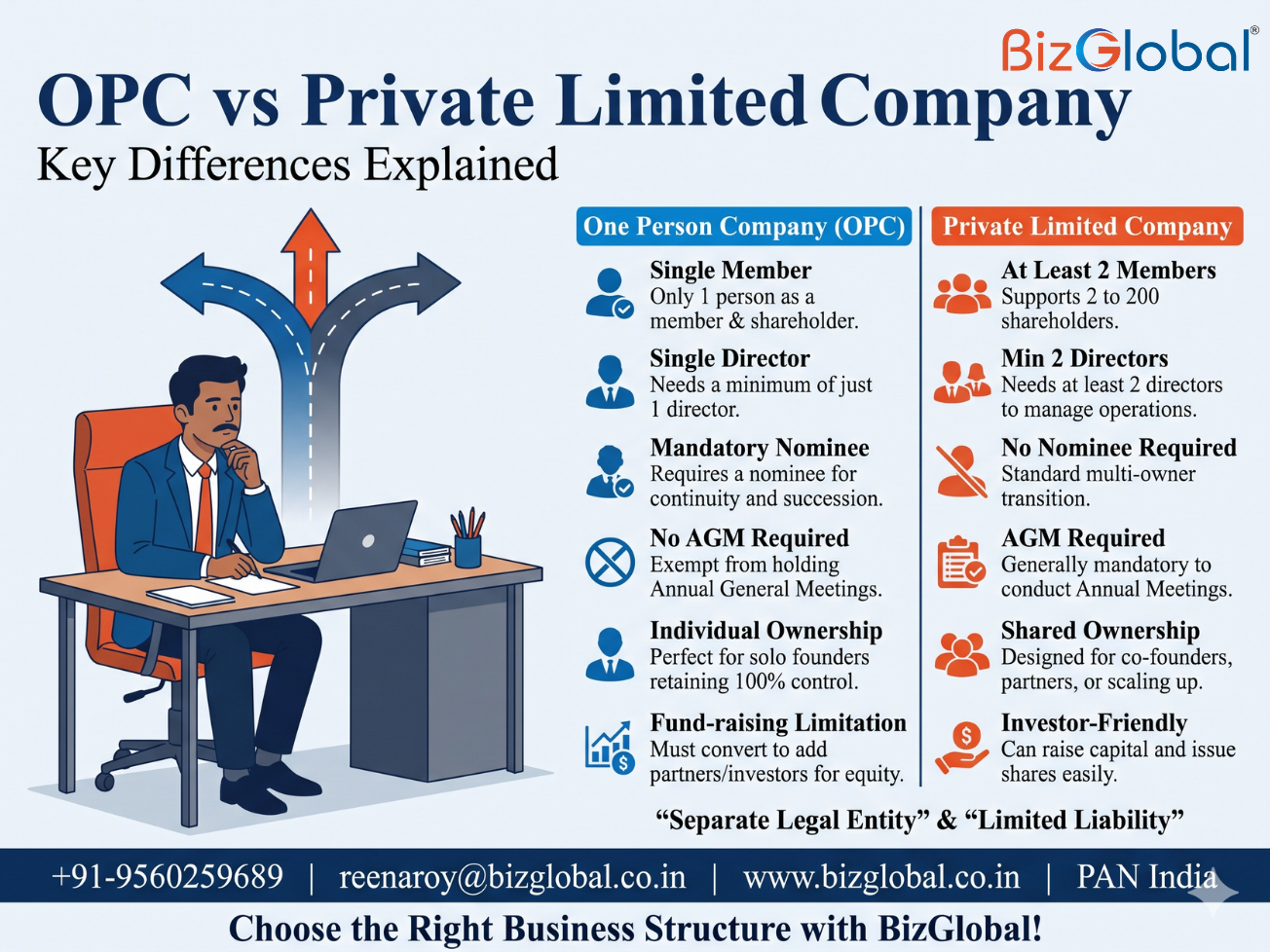
Choosing the right business structure is one of the first important decisions an entrepreneur makes. While some founders want complete ownership and control over their business, others plan to bring in co-founders, investors or strategic partners as the business grows.
For an individual entrepreneur, a One Person Company (OPC) may appear to be the natural choice. However, a Private Limited Company may be more suitable when the business requires multiple shareholders or has plans for external investment.
Both structures are governed by the Companies Act, 2013. Both provide a separate legal identity and, when incorporated as companies limited by shares, a limited-liability framework. However, they differ in ownership, minimum membership, management, compliance requirements and future flexibility.
This article explains the OPC vs private limited company comparison to help founders make an informed incorporation decision.
A. What Is a One Person Company (OPC)?
A One Person Company is a company that has only one person as its member.
Section 2(62) of the Companies Act, 2013 defines an OPC as a company having only one person as a member. It is a special category of private company that allows an individual to operate through a separate corporate entity.
An OPC requires a nominee who may become its member in the event of the sole member's death or incapacity to contract, as prescribed under Section 3(1) of the Act.
It is suitable for an entrepreneur who wants to retain single-member ownership while operating through a formal corporate structure.
B. What Is a Private Limited Company?
A Private Limited Company is a company incorporated under the Companies Act, 2013 with at least two members.
Under Section 2(68), a private company must restrict the right to transfer its shares through its articles, limit its membership to 200 (subject to the statutory exclusions) and prohibit invitations to the public to subscribe for its securities.
Unlike an OPC, a private limited company can have multiple shareholders. This makes it a commonly considered structure for businesses with co-founders, investors or plans to raise equity capital.
3. OPC vs Private Limited Company: Key Differences
The following table highlights the major differences between the two structures.
|
Basis |
One Person Company |
Private Limited Company |
|
Minimum members |
One |
Two |
|
Maximum members |
One |
200, subject to statutory exclusions |
|
Minimum directors |
One |
Two |
|
Ownership |
Single-member ownership |
Multiple shareholders permitted |
|
Nominee |
Mandatory |
Not required in the same manner |
|
Legal identity |
Separate legal entity |
Separate legal entity |
|
Liability |
Limited, where incorporated as a company limited by shares, subject to legal exceptions |
Limited, where incorporated as a company limited by shares, subject to legal exceptions |
|
Shareholding flexibility |
Cannot have more than one member while it remains an OPC |
Can accommodate multiple shareholders |
|
Share transfer |
Subject to applicable law and the company's constitutional documents |
Restricted by the articles and applicable law |
|
AGM |
Not required |
Generally required |
|
Board meetings |
Special provisions and relaxations apply |
General provisions apply, subject to applicable exemptions |
|
Statutory audit |
Mandatory |
Mandatory |
|
Annual return |
Generally Form MGT-7A |
Generally Form MGT-7, or MGT-7A if eligible as a small company |
|
Financial statement filing |
Form AOC-4 |
Form AOC-4 |
|
Fundraising through equity |
Requires conversion before admitting another member |
Can issue shares subject to applicable legal requirements |
|
Conversion |
Can convert into a private or public company |
Can be converted into an OPC if the applicable conditions are met |
Can an OPC Be Converted Into a Private Limited Company?
Yes. An OPC can be converted into a private limited company by following the prescribed procedure.
Under Rule 6 of the Companies (Incorporation) Rules, 2014, the conversion process generally involves:
- Increasing the number of members to at least two.
- Increasing the number of directors to at least two.
- Altering the Memorandum of Association (MOA) and Articles of Association (AOA).
- Passing the required resolution in accordance with Section 122(3).
- Complying with Section 18 of the Companies Act, 2013.
- Filing the prescribed application in Form INC-6 with the required attachments and fees.
The prescribed attachments include the altered MOA and AOA, resolution, proposed members' and directors' details and consents, list of creditors and latest audited financial statements.
The Registrar of Companies reviews the application and, upon satisfaction that the requirements have been complied with, issues the conversion certificate.
A Practical Example
Suppose two entrepreneurs are planning to launch an online retail business together.
They want to contribute capital in different proportions, share ownership and potentially bring in an investor in the future.
A private limited company may be more suitable because it permits multiple shareholders.
Now consider an individual consultant who wants to establish a formal company, retain sole ownership and operate independently.
An OPC may be worth considering.
The correct choice is not determined by business size alone. Ownership plans, funding requirements, liability considerations and compliance capacity matter just as much.
How BizGlobal Can Help?
Selecting the right company structure at the beginning can help avoid unnecessary restructuring and procedural complications later.
BizGlobal can assist entrepreneurs with understanding the differences between OPC and private limited company structures, assessing incorporation-related requirements and organising the documentation and procedural steps involved in company registration.