
One Person Companies (OPCs) provide individual entrepreneurs with a separate legal identity and limited liability. However, operating as an OPC also involves statutory financial compliance. A common question is whether an OPC must undergo an audit even if it has low turnover or has not commenced business.
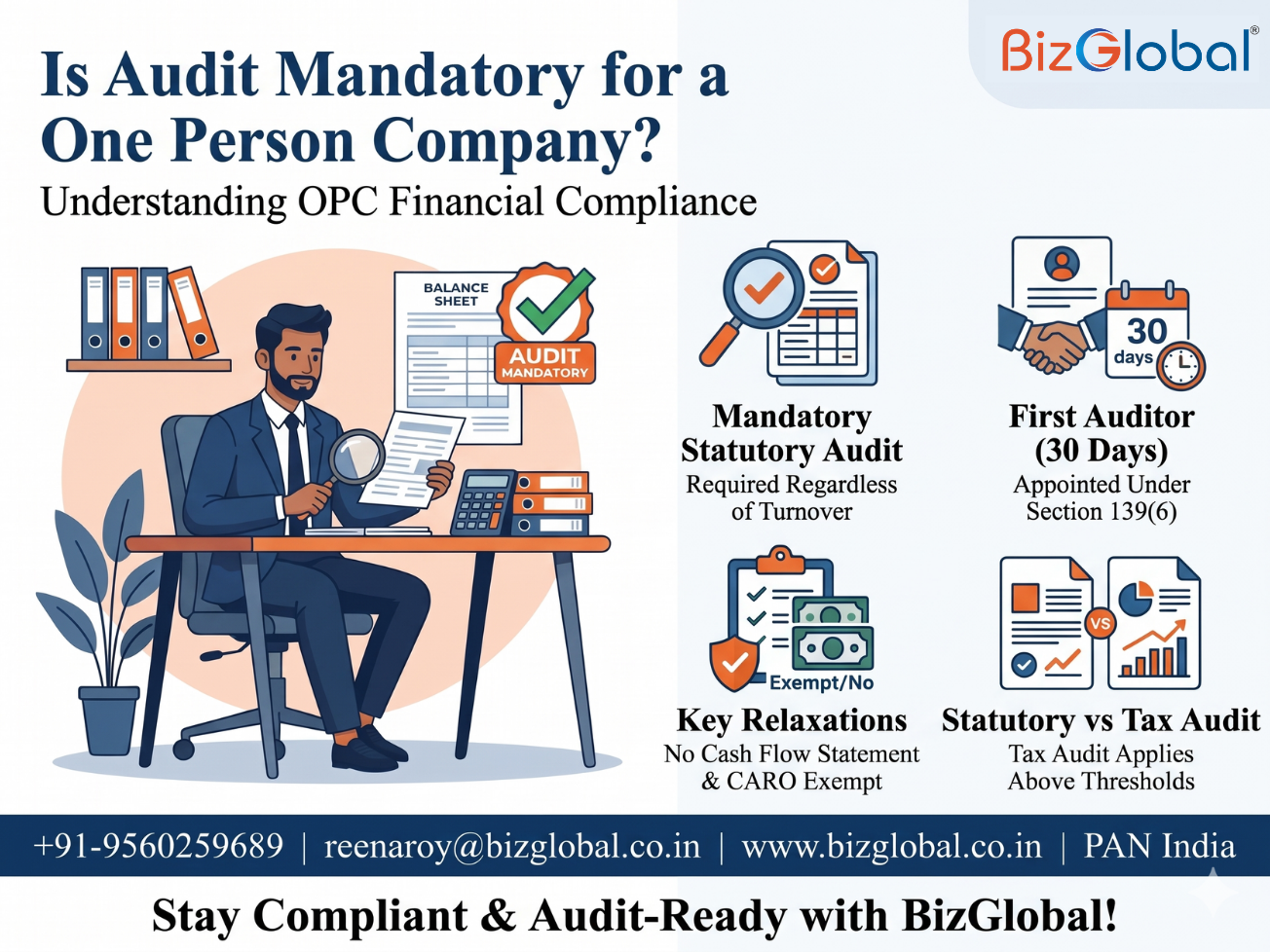
Yes. Statutory audit is mandatory for every OPC under the Companies Act, 2013, irrespective of turnover, profitability, number of transactions or business activity. Although OPCs enjoy certain compliance relaxations, they are not exempt from statutory audit.
Is Statutory Audit Mandatory for an OPC?
Yes. Every OPC must get its financial statements audited under the Companies Act, 2013.
The requirement is governed primarily by Sections 139, 141 and 143. An OPC cannot claim exemption merely because:
- It has low turnover or has incurred losses.
- It has not commenced business operations.
- It has no revenue during the financial year.
- It has undertaken very few transactions.
Example: An OPC incorporated during the year but yet to commence operations must still maintain its books, prepare financial statements and complete its statutory audit.
Appointment of the First Auditor
Under Section 139(6), the Board of Directors must generally appoint the first auditor within 30 days of incorporation. If the Board fails, the members must appoint the auditor within the prescribed further period.
An OPC must follow the applicable appointment procedure, considering the special provisions under Section 122.
The company should:
- Identify an eligible Chartered Accountant or audit firm.
- Obtain the auditor's written consent and eligibility certificate.
- Complete the appointment within the statutory timeline.
- Maintain relevant appointment records.
The statutory auditor must satisfy the eligibility and independence requirements under Section 141.
What Does the Statutory Auditor Examine?
The auditor independently examines the company's financial statements and supporting records. This generally includes:
- Books of account and accounting entries.
- Balance Sheet and Statement of Profit and Loss.
- Bank statements, invoices and expense vouchers.
- Loan agreements and outstanding liabilities.
- Fixed asset records and applicable tax records.
- Related-party transactions and statutory disclosures.
The auditor evaluates whether the financial statements present a true and fair view of the company's financial position and performance.
Financial Statements and Available Relaxations
Under Section 129, an OPC must prepare its financial statements, generally comprising:
- Balance Sheet.
- Statement of Profit and Loss.
- Notes to accounts.
Cash flow statement exemption: Under Section 2(40), an OPC is not required to include a cash flow statement as part of its financial statements.
Further, Section 134(1) permits the financial statements of an OPC to be signed by only one director for submission to the auditor.
These relaxations do not remove the statutory audit requirement.
Is Tax Audit Also Mandatory for an OPC?
Statutory audit and tax audit are separate requirements.
Statutory audit is mandatory for every OPC under the Companies Act, whereas tax audit depends on the conditions prescribed under income-tax legislation.
For tax years beginning on or after 1 April 2026, the Income-tax Act, 2025 applies. Section 63 governs tax audit requirements. Broadly, the thresholds include:
- Business: Turnover exceeding ₹1 crore, (or ₹10 crores if cash receipts and cash payments do not exceed 5% of total transactions)
- Profession: Gross receipts exceeding ₹50 lakh.
Additional conditions, including those relating to presumptive taxation, may apply.
Therefore, an OPC may require statutory audit even when it does not meet the conditions for tax audit.
What Happens If an OPC Does Not Conduct an Audit?
Failure to complete statutory audit can result in non-compliance with the Companies Act and delay annual ROC filings.
Possible consequences include:
- Incomplete audited financial statements.
- Delay in filing Form AOC-4.
- Additional filing fees and applicable statutory penalties.
- Difficulties during financial due diligence or loan applications.
- Inadequate financial records for assessing business performance.
An OPC must file its financial statements within 180 days from the closure of the financial year, as prescribed under Section 137.
How Can BizGlobal Help?
Managing OPC financial and ROC compliance can be challenging for first-time entrepreneurs. BizGlobal can assist with identifying applicable compliance requirements, reviewing the ROC filing position, documentation and procedural coordination for AOC-4 and MGT-7A, and maintaining an annual compliance calendar.
Statutory audit must be conducted by an eligible auditor appointed under the Companies Act, 2013.