
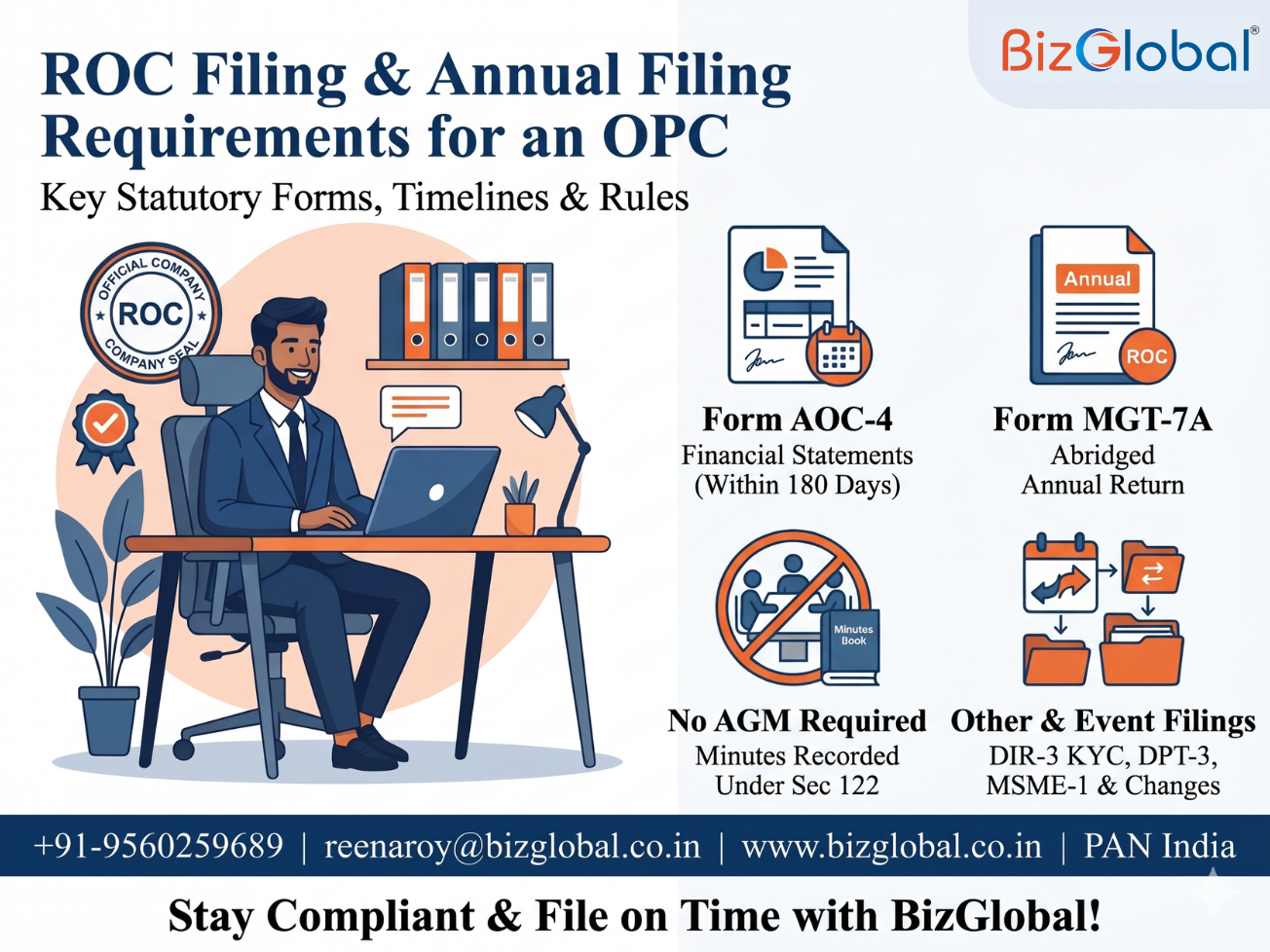
Incorporating a One Person Company (OPC) provides an individual entrepreneur with the benefit of operating through a separate legal entity. However, incorporation is only the beginning. An OPC must fulfil ongoing statutory responsibilities, including filing prescribed documents and returns with the Registrar of Companies (ROC).
Although an OPC receives certain procedural relaxations under the Companies Act, 2013, it is not exempt from annual compliance requirements. The two principal annual filings are Form AOC-4 and Form MGT-7A.
Understanding OPC annual filing requirements is essential because delayed or incorrect filings may result in additional fees, statutory penalties and difficulties during future corporate transactions.
What Are the Annual Filing Requirements for an OPC?
Annual filing refers to submitting prescribed documents and returns to the ROC for every financial year.
The two principal annual filings are:
- Form AOC-4: Filing of financial statements.
- Form MGT-7A: Filing of the annual return.
AOC-4 provides financial information about the company, whereas MGT-7A contains details relating to its corporate structure, membership, shareholding and directors.
The applicable legal framework includes the Companies Act, 2013, and the relevant Companies Rules.
OPC Annual ROC Filing Checklist
|
Filing / Requirement |
Form / Provision |
General Timeline |
|
AOC-4 |
Within 180 days from closure of financial year |
|
|
MGT-7A |
Within 60 days of deemed AGM date |
|
|
Sections 139 and 143 |
Every financial year |
|
|
DIR-3 KYC Web |
Once every third consecutive financial year, subject to applicable conditions |
Form AOC-4: Filing of Financial Statements
Under Section 137 of the Companies Act, 2013, an OPC must file its duly adopted financial statements with the ROC within 180 days from the closure of the financial year.
For an OPC following the financial year from 1st April to 31st March, the general deadline is 27th September.
Documents generally required include:
- Balance Sheet.
- Statement of Profit and Loss.
- Notes to accounts.
- Auditor's Report.
- Board's Report.
- Other prescribed statements and disclosures, as applicable.
An OPC is not required to include a cash flow statement under the proviso to Section 2(40) of the Companies Act, 2013.
The financial statements must be properly prepared, audited and approved in accordance with the applicable provisions. In an OPC, the financial statements may be signed by one director for submission to the auditor.
The sole member's approval must also be appropriately recorded.
Form MGT-7A: Annual Return for an OPC
Under Section 92, an OPC must file its annual return with the ROC using Form MGT-7A, the prescribed abridged annual return for OPCs and small companies.
The information should be consistent with the company's statutory registers and other ROC filings.
Due date: Section 92(4) generally requires an annual return to be filed within 60 days from the date of the AGM or, where no AGM is held, within 60 days from the date on which the AGM should have been held.
Since an OPC is exempt from holding an AGM under Section 96, its applicable filing timeline must be determined by considering the special provisions applicable to OPCs and current MCA instructions.
The annual return is signed by a Company Secretary, where the company has one, or by a director where it does not.
Does an OPC Need to Hold an AGM?
No. Section 96 exempts an OPC from holding an Annual General Meeting.
However, this does not eliminate its annual approval and filing responsibilities.
Section 122 provides a special mechanism for recording decisions of the sole member. The member's decision must be communicated to the company and entered in the minutes book, duly signed and dated.
Consequences of Non-Filing
Failure to complete annual ROC filings may result in:
Additional filing fees: Delayed forms may attract additional fees under applicable rules.
Statutory penalties: Sections 92 and 137 provide for penalties for defaults relating to annual returns and financial statements.
Director disqualification: Section 164(2) provides for disqualification in specified circumstances where a company fails to file financial statements or annual returns for three continuous financial years.
Business difficulties: Pending filings may create complications during bank loan applications, due diligence, restructuring, changes in directors and company closure proceedings.
How BizGlobal Can Help?
Annual ROC filing involves more than completing online forms. It requires proper documentation, verification of statutory records and compliance with applicable timelines.
BizGlobal can assist OPC owners with:
- Reviewing annual filing requirements.
- Identifying applicable ROC forms.
- Organising supporting documents.
- Assisting with AOC-4 and MGT-7A preparation and filing procedures.
- Reviewing additional and event-based compliance requirements.
- Identifying pending ROC filings.