
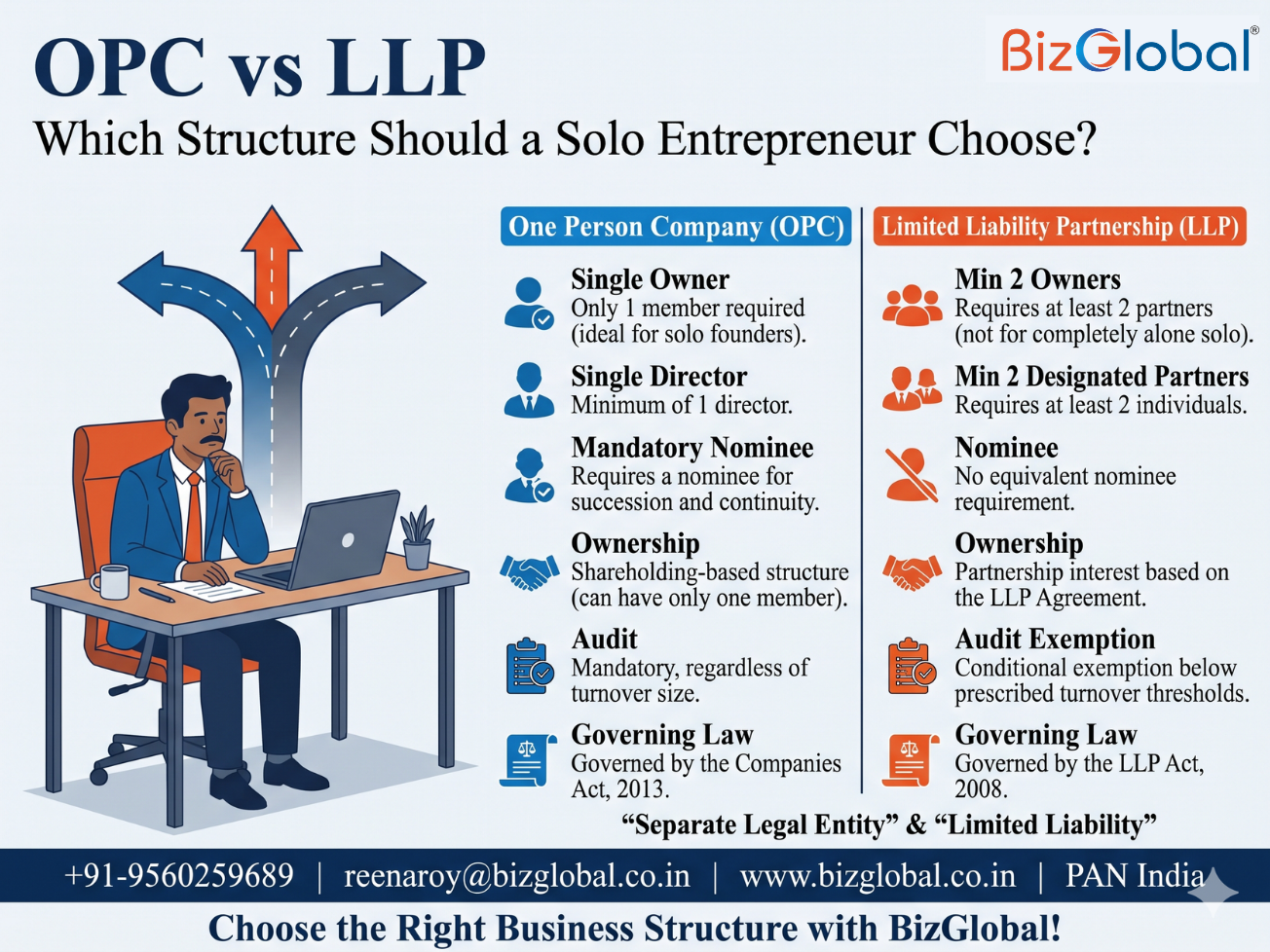
Starting a business independently involves more than deciding what product or service to offer. An entrepreneur must also choose a suitable legal structure that supports the business's operations, ownership preferences and future plans.
In India, a One Person Company (OPC) and a Limited Liability Partnership (LLP) are two formal business structures that offer a separate legal identity and a framework for limiting personal liability. Both can be suitable for professional and service-oriented businesses, but they operate under different laws and have different ownership requirements.
The most important distinction is that an OPC can be incorporated by one eligible individual, whereas an LLP requires at least two partners.
This makes the comparison of OPC vs LLP particularly important for solo entrepreneurs who want to retain control while deciding whether they are comfortable bringing another person into the business structure.
Let's understand the differences and identify which structure may be more suitable for different business needs.
A. What Is a One Person Company (OPC)?
A One Person Company is a company incorporated under the Companies Act, 2013 with only one person as its member.
Section 2(62) of the Companies Act, 2013 defines an OPC as a company having only one person as a member.
An OPC provides a separate legal identity to an individual entrepreneur. It can own assets, enter into contracts, maintain bank accounts and carry on business in its own name.
An OPC also requires a nominee who may become its member in the event of the sole member's death or incapacity to contract, as prescribed under Section 3(1) of the Act.
It is generally suitable for an individual who wants to retain sole membership while operating through a corporate structure.
B. What Is a Limited Liability Partnership (LLP)?
A Limited Liability Partnership is a business structure governed by the Limited Liability Partnership Act, 2008.
An LLP combines certain features of a traditional partnership with the benefit of a separate legal identity and limited liability.
Under Section 3 of the LLP Act, an LLP is a body corporate and a legal entity separate from its partners. It has perpetual succession, meaning changes in its partners do not automatically affect its existence.
An LLP requires at least two partners and at least two designated partners, who must be individuals. At least one designated partner must satisfy the prescribed Indian residency requirement.
The partners generally determine their mutual rights, duties, profit-sharing arrangements and management responsibilities through the LLP Agreement.
An LLP is often considered by professional firms, consultants and businesses where two or more individuals want to work together under a formal business structure.
OPC vs LLP: Key Differences
The following table highlights the major differences between an OPC and an LLP.
|
Basis |
One Person Company |
Limited Liability Partnership |
|
Governing law |
Companies Act, 2013 |
LLP Act, 2008 |
|
Legal status |
Separate legal entity |
Separate legal entity and body corporate |
|
Minimum owners |
One member |
Two partners |
|
Maximum owners |
One member |
No general statutory maximum number of partners |
|
Management |
Managed through its director or directors |
Managed by partners in accordance with the LLP Agreement |
|
Minimum directors/designated partners |
One director |
Two designated partners |
|
Nominee |
Mandatory |
No equivalent OPC nominee requirement |
|
Ownership structure |
Shareholding |
Partnership interest and contribution |
|
Liability |
Generally limited to unpaid amount on shares, subject to legal exceptions |
Generally limited to agreed contribution, subject to legal exceptions |
|
Governing document |
MOA and AOA |
LLP Agreement |
|
Mandatory |
Conditional exemption available under prescribed thresholds |
|
|
AOC-4 and MGT-7A |
Form 8 and Form 11 |
|
|
AGM |
Not required |
No company-style AGM requirement |
|
Compliance framework |
Company-law compliance |
LLP-law compliance |
|
Suitable for |
Individual entrepreneurs |
Two or more persons operating together |
How BizGlobal Can Help?
Choosing between an OPC and an LLP requires an understanding of the founder's ownership preferences, business model, expected income, management arrangements and future growth plans.
BizGlobal can assist entrepreneurs with understanding the differences between business structures, assessing incorporation-related procedural requirements and organising the documentation required for registration.