
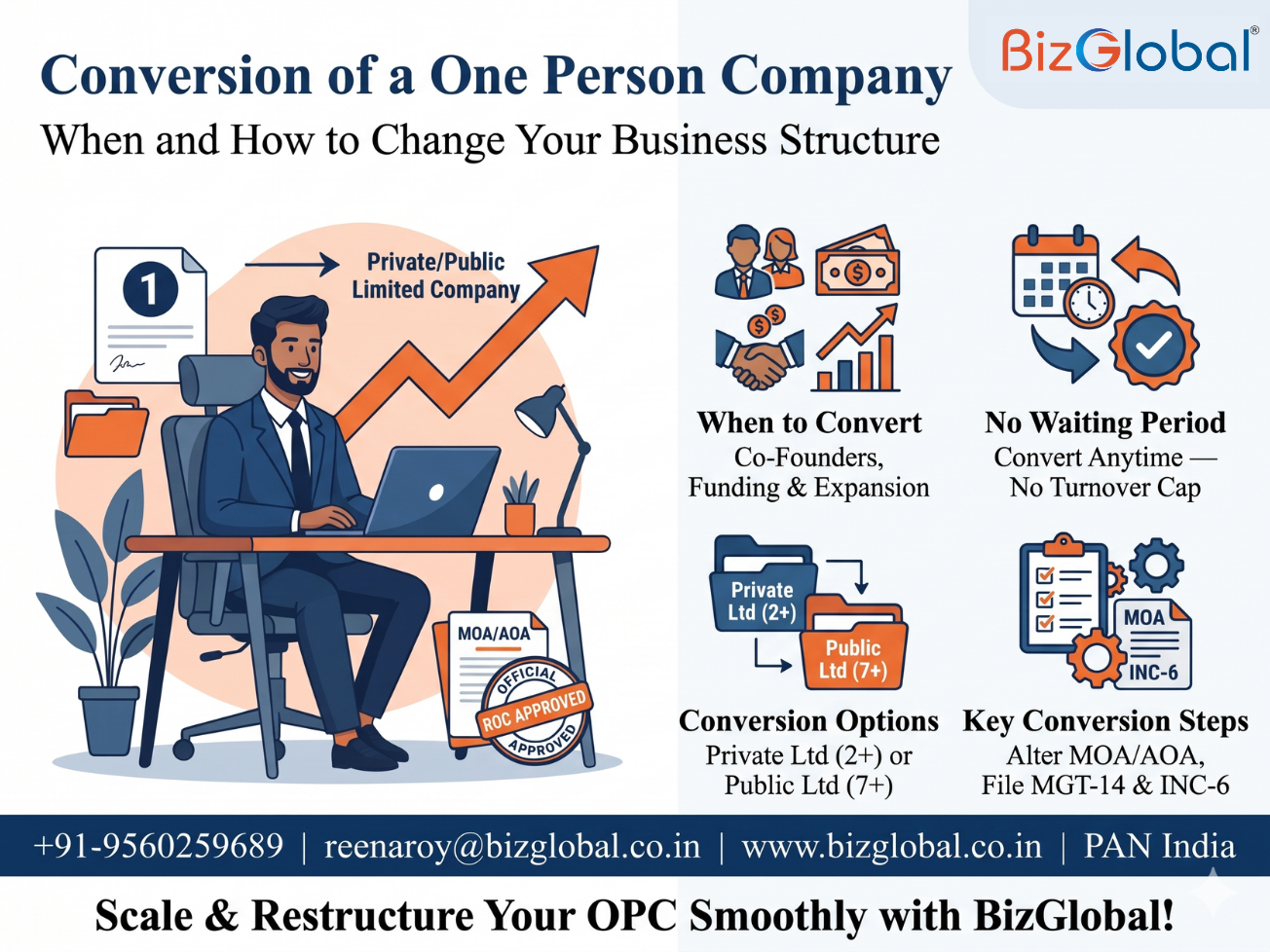
A One Person Company (OPC) is a suitable starting point for entrepreneurs who want to operate through a registered company while retaining sole ownership and control. However, as a business grows, its requirements may change. Bringing in a co-founder, introducing investors or expanding operations may make a different corporate structure more suitable.
The Companies Act, 2013 permits an OPC to convert into a private limited company or a public limited company by following the prescribed procedure. The 2021 amendment also removed the earlier two-year waiting period and mandatory conversion thresholds.
This article explains when conversion is appropriate, the legal provisions, procedure, documents and compliance implications.
What Is OPC Conversion?
OPC conversion means changing an existing One Person Company into another class of company under Section 18 of the Companies Act, 2013, read with Rule 6 of the Companies (Incorporation) Rules, 2014.
An OPC can convert into:
The process involves altering the Memorandum of Association (MOA) and Articles of Association (AOA), meeting the membership and director requirements and filing Form INC-6 with the Registrar of Companies (ROC).
It is a statutory conversion, not the closure of the existing company followed by incorporation of a new one.
When Should an OPC Consider Conversion?
Conversion may be appropriate when:
Bringing in a co-founder: An OPC permits only one member. A private limited company allows the founder to introduce additional shareholders and share ownership.
Raising equity investment: Businesses planning to raise equity funding may prefer a private limited structure, which accommodates multiple shareholders and investment arrangements.
Expanding management: Growing businesses may require additional shareholders, directors and a broader ownership structure.
Business expansion: Strategic partnerships, equity-based incentives and succession planning may make conversion beneficial.
Planning public fundraising: Businesses considering wider ownership and public capital-raising opportunities may eventually explore conversion into a public company.
OPC to Private Limited vs Public Limited Company
|
Particulars |
Private Company |
Public Company |
|
Minimum members |
2 |
7 |
|
Minimum directors |
2 |
3 |
|
Ownership |
Privately held |
Wider ownership permitted |
|
Fundraising |
Private investment |
Wider capital-raising opportunities, subject to law |
|
Compliance |
More than OPC |
Generally more extensive |
For most growing OPCs, conversion into a private limited company is a practical option. There is no general minimum paid-up capital requirement for ordinary private or public companies under the Companies Act, 2013.
Prohibited Conversions
The One Person Company shall not be converted into Section 8 Company.
Step-by-Step Conversion Procedure
Step 1: Decide the proposed structure. Determine whether a private or public company better suits the proposed ownership, capital and management requirements.
Step 2: Meet membership and director requirements. A private company requires at least two members and two directors, while a public company requires at least seven members and three directors.
Step 3: Record the member's decision. The sole member must approve the conversion and alterations to the MOA and AOA. The decision must be recorded under Section 122(3).
Step 4: Alter MOA and AOA. Update the company's name, membership provisions, director clauses and other provisions to reflect the proposed structure.
Step 5: Prepare documents. Arrange the altered MOA and AOA, member's resolution, proposed members' and directors' details and consents, creditors' list and latest audited financial statements.
Step 6: File MGT-14 and INC-6. As required by the current MCA INC-6 instruction kit, complete the applicable MGT-14 filing and obtain approval before submitting INC-6 with supporting documents and prescribed fees.
Step 7: Obtain ROC approval. The ROC examines the application and issues the prescribed certificate upon satisfaction of the requirements.
Step 8: Complete post-conversion formalities. Update company records, statutory registers, bank details, GST registrations, licences, contracts and business documents wherever required.
What Happens to Existing Liabilities?
Under Section 18(3), conversion does not affect debts, liabilities, obligations or contracts incurred before conversion.
Existing loans, creditor balances and contractual commitments continue. Therefore, conversion cannot be treated as a means of avoiding existing obligations.
The company should also review financing agreements and material contracts for any notice or consent requirements.
How Can BizGlobal Help?
OPC conversion involves legal documentation, corporate restructuring and ROC filings. BizGlobal can provide compliance guidance within its confirmed service scope, including reviewing the proposed structure, preparing documentation checklists, assisting with MOA and AOA alterations, coordinating MGT-14 and INC-6 filings, and identifying post-conversion compliance requirements.